Best Plywood for Shoe Rack: A Complete Thickness and Material Guide
September 18, 2026
Table of Contents
For most standard home shoe cabinets, the best plywood for shoe racks is 18mm Moisture Resistant Plywood. This thickness provides good strength and stability for shelves and cabinet components, while moisture-resistant plywood is suitable where the shoe rack may experience occasional moisture. Besides thickness, check the quality of the core, moisture resistance, screw-holding capacity, dimensional stability and termite protection.
A shoe rack must bear repeated loads while staying stable in everyday use. The shelves carry concentrated loads, while the hinges and lower parts may also be exposed to moisture from footwear or cleaning.
This is why it is important to select the right plywood for a shoe rack. The right plywood thickness and grade will depend on the dimensions of the cabinet, the span of the shelf, the support arrangement and the expected load.
For most domestic cabinets, 16mm offers a good compromise of strength and material efficiency. 19mm plywood is more suitable for larger racks with wider shelves.
This blog provides an overview of the best thickness of plywood that can be used in shoe racks. It discusses the use of 12mm, 16mm, 19mm and 25mm plywood. The role of plywood grade, core quality, the span of the shelf and imposed weight are also analysed.
What Is the Ideal Thickness for a Shoe Rack?
The right plywood thickness for a shoe rack depends mainly on the span of the shelves, the load and support spacing. A thicker board doesn't automatically solve the problem if the cabinet design itself is poorly supported.
12mm Plywood
12mm plywood is suitable for compact shoe racks for light loads and short shelves. It works better if the shelves have more vertical supports that shorten the unsupported span.
But if you want wide shelves that hold lots of pairs of shoes, 12mm may provide less rigidity for a shoe rack carrying multiple pairs of shoes.
16mm Plywood
16mm Plywood is a practical option for most residential shoe cabinets. It is a good compromise of weight, storage capacity, cost and stiffness.
Suitable for the shelves, side panels and partitions in standard cabinet designs, 16mm MR plywood is a good combination for daily household use where moisture resistance is also needed.
19mm Plywood
19mm plywood is more suitable for larger cabinets, wider shelves and heavier loads. The increased thickness increases the rigidity and may help to reduce shelf sagging.
This is particularly useful where shelves have longer unsupported spans or use fewer vertical partitions in the design.
25mm Sheet Plywood
For a normal household shoe rack, 25mm plywood is generally not needed. It may be justified for specialised heavy-duty furniture, but using it throughout an ordinary cabinet adds unnecessary weight and material cost.
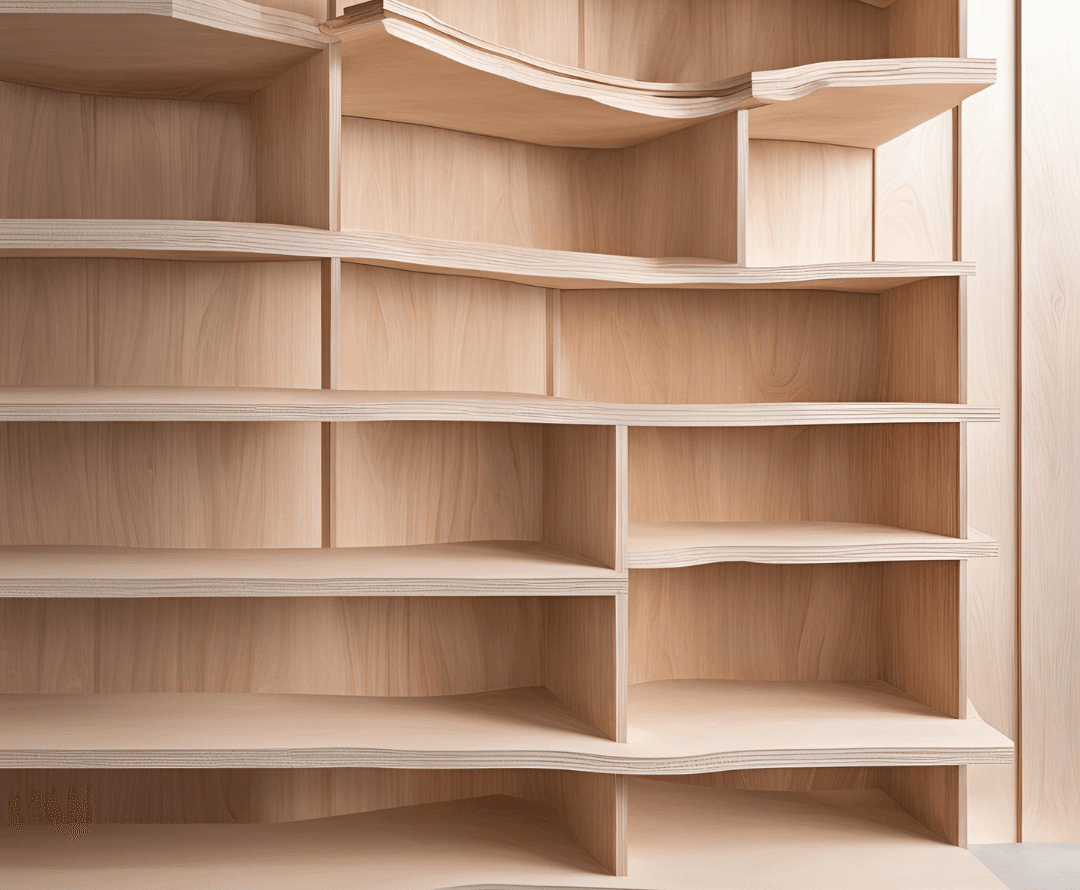
The shoe rack's design determines the type of plywood thickness and amount of support that can be used. When choosing the design of the rack, you have to take into account factors such as arrangement of shelves, volume of storage, available space, and design of your cabinets. Check out these plywood shoe rack designs that will inspire you.
Plywood Thickness Guide
| Shoe Rack Design | Suitable Thickness |
|---|---|
| Compact/lightweight rack with short spans | 12–16mm |
| Standard residential cabinet | 16mm |
| Large cabinet | 16–19mm |
| Wide/heavy-load shelves | 19mm |
| Special heavy-duty use | 19–25mm |
These are practical furniture guidelines rather than engineering calculations. The real requirements depend on the dimensions of the shelf, the spacing of the supports, the method of fixing and the distribution of the load.
For example, a 900mm shelf with a central support has a much shorter unsupported span than a 1500mm shelf supported only at the ends. The longer span is more likely to sag under load and may therefore require thicker plywood or additional intermediate support.
Why Is Moisture Resistant Plywood Better for a Shoe Rack?
When choosing which plywood is best for a shoe rack, look beyond thickness and consider moisture resistance.
Rainwater, mud, and moisture can be brought into a cabinet by shoes. A shoe rack near an entrance can also be exposed to dampness when cleaning the floor. Repeated exposure can affect plywood that is not intended for wet conditions.
Moisture-resistant plywood is made for uses where there is a need for increased resistance to water and moisture. It’s a better option than regular interior-grade plywood for shoe cabinets that may be subject to occasional contact with moisture.
When Should You Upgrade to BWR or BWP Plywood?
MR plywood covers most shoe racks well, but it isn't the right choice for every situation. If your shoe rack faces more than occasional moisture, it's worth stepping up a grade.
Choose BWR plywood if:
- The rack sits in a covered but exposed entryway (porch, balcony, semi-outdoor mudroom)
- The area sees regular floor cleaning or mopping nearby
- You want better moisture protection than MR without paying BWP prices
BWR plywood uses phenol-formaldehyde resin bonding, which gives it stronger moisture resistance and durability than MR, while staying more affordable than BWP.
Choose BWP (marine-grade) plywood if:
- The shoe rack is installed outdoors or in a monsoon-prone, humid coastal region
- It's regularly exposed to direct rain, standing water, or high humidity
- You're prioritising maximum lifespan and are open to a higher budget
BWP Plywood is the most water-resistant and structurally strongest of the three grades, though it comes at a higher cost.
Quick comparison:
| Grade | Best For | Water Resistance | Relative Cost |
|---|---|---|---|
| MR | Standard indoor shoe racks, occasional moisture | Moderate | Lowest |
| BWR | Covered entryways, semi-exposed areas | High | Medium |
| BWP/Marine | Outdoor or heavily monsoon-exposed racks | Very High | Highest |
For most homes, 18mm MR plywood remains the sensible default. But if your shoe rack sits somewhere genuinely wet — not just "occasionally damp" — upgrading to BWR or BWP will save you from swelling, delamination, and early replacement.
Why Does Core Quality Matter?
Plywood thickness is not the sole determinant of performance. Internal core construction influences strength, stability and screw-holding strength.
Shoe cabinets use screws for hinges, handles, shelf supports and joints. Poorly made cores can have gaps or weak spots that cause issues around fixing points.
Inspect the exposed edge for any obvious gaps, overlaps or badly formed layers. A consistent core construction offers a more dependable base for cabinet assembly.
Screw-holding strength also depends on the type of screw, the fixing position, the edge distance and the workmanship.
Does Shelf Span Affect Plywood Thickness?
Yes. Shelf span is an important factor when choosing plywood thickness for shoe rack construction.
A shelf supported at both ends and by a central partition can carry more weight with less sag than a shelf of the same overall length supported only at its ends.
Here is a practical guide:
- Short span + medium load: 12–16mm
- Medium span + normal load: 16mm
- Long span + higher load: 19mm
- Very large span: Add intermediate support
In some cases, to improve shelf performance, adding a vertical partition can be more effective than simply increasing the thickness of the plywood.
16mm vs 19mm: Which Thickness Should You Choose?
For a standard residential shoe cabinet, 16mm is usually the better-balanced option. It has enough rigidity for many common layouts without adding unnecessary weight to the cabinet. Go for 19mm where the cabinet has wider compartments, longer unsupported shelves, fewer partitions or greater expected loading.
One simple rule:
Standard shoe cabinet for home → 16–18mm Large or heavy-duty cabinet → 18–19mm
The final specification should be based on the actual dimensions of the cabinet.
What Should You Check Besides Plywood Thickness?
There are certain specifications that you need to check for the best plywood for shoe rack making.
BIS Certification
Verify whether the plywood carries the BIS mark according to the grade it is claiming. This gives a recognised benchmark when comparing plywood products.
Water Resistance
For cabinets near entryways, service areas or anywhere wet footwear is usually stored, MR plywood is a suitable option.
Core Construction
Look for a consistent core with no obvious gaps or overlaps. Core consistency is particularly important at screw and joint locations.
Thickness Uniformity
Consistent thickness helps panels fit accurately where they are cut, assembled and finished with laminate, veneer or paint.
Termite and Borer Protection
Ask whether the plywood has been treated to resist termites and borers. This is an important consideration for furniture over the long term.
Fastener Performance
Strong screw-holding capacity is useful for hinges, handles, partitions and shelf supports. Installation quality is just as important.
Should All Shoe Rack Components Have the Same Thickness?
Not necessarily. Different elements have different structural functions.
Shelves and side panels generally carry or transfer more load, whereas a back panel might primarily serve to enclose and help keep it aligned.
For appropriate non-load-bearing components, thinner plywood can be used to reduce material usage. But the thickness should depend on how the cabinet is constructed and not just one thickness for all panels.
How Can You Build a Shoe Rack That Lasts?
The best plywood for a shoe rack may not last long if the cabinet is poorly designed.
Provide Adequate Shelf Support
Use vertical partitions or suitable supports under long shelving to reduce the unsupported span.
Protect Exposed Plywood Edges
Finish or seal exposed edges, especially around the bottom of the cabinet where moisture may be present.
Keep the Base Moisture-Free
A good plinth or raised base will reduce direct contact of the plywood with wet flooring.
Allow Adequate Airflow
Closed shoe cabinets can trap moisture and odours. Adequate ventilation may improve air circulation in the storage compartments.
Use Suitable Hardware
Choose suitable hinges, screws and shelf supports for cabinet construction. The right fixing technique will help you keep your joints strong.
How Can You Choose Plywood Without Over-Specifying?
Sometimes the thickest plywood you can get isn’t the most economical choice. Using excessive thickness may lead to unnecessary increases in cost, weight and material usage.
Decide before you buy:
- Cabinet height and width
- Depth of shelf
- Longest unsupported span
- Number of vertical partitions
- Expected load of footwear
- Moisture contact
- Cabinet placement
- Hardware requirements
These factors suggest 18 mm MR plywood for most standard residential cabinets. 19mm may be justified for larger designs.
Conclusion
18 mm MR plywood is a sensible choice for most home shoe cabinets. It offers a good combination of strength, durability, moisture resistance and material efficiency. 19mm is better for wider shelves, heavier loads or longer unsupported lengths.
Thickness is not the only factor on which the choice should be made. Also, the finished cabinet is influenced by plywood grade, core construction, moisture resistance, calibration, fastening performance, and termite protection.
If you are deciding which plywood is best for a shoe rack, first consider the dimensions of the cabinet and the load it is expected to bear. Then choose the thickness and grade to meet those requirements.
Frequently Asked Questions
What Thickness of Plywood Is Recommended for a Shoe Rack?
Most standard residential shoe racks can use 16mm plywood. For larger cabinets, wider shelves, or heavier loads, 19mm may be required.
Can 12mm Plywood Be Used for a Shoe Rack?
Yes. It works well for small racks with short shelf spans and lighter loads. For standard multi-shelf cabinets, 16mm provides more rigidity.
Is BWP Plywood Suitable for a Shoe Rack?
Yes. BWP plywood is especially useful if the cabinet may be exposed to moisture from wet footwear, rainwater or floor cleaning.
Is BWR Plywood Suitable for a Shoe Rack?
Yes. BWR plywood is a good middle option for shoe racks in covered but exposed spots, like porches, balconies, or entryways that see regular cleaning or mild dampness. It offers better moisture resistance than MR without the higher cost of BWP.
Is 19mm Plywood Better Than 16mm Plywood?
For larger or heavier-duty designs, 19mm is more suitable, while 16mm is usually sufficient for standard residential shoe cabinets.
What Should You Consider When Buying Plywood for a Shoe Rack?
Check for the plywood grade, BIS certification, core construction, moisture resistance, calibration, fastening performance and termite protection. Along with these factors, thickness is important.

Related Blogs