
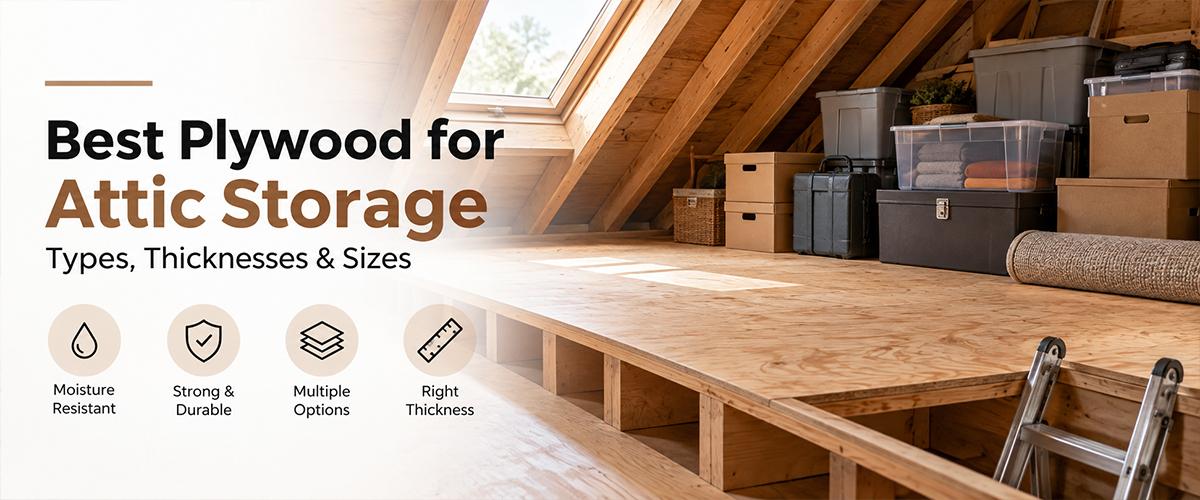
Best Plywood for Attic Storage – Types, Thicknesses & Sizes
September 23, 2026
Table of Contents
Waterproof Plywood is a practical choice for plywood for attic storage where humidity, condensation or occasional moisture exposure is possible. For attics where strength and heavier storage loads are a priority, go with Hardwood Plywood. For attics where consistent thickness and precise fitting are key, Calibrated Plywood is a good option. For many well-supported attic platforms, 18mm plywood is a good starting point, though the required thickness will depend on joist spacing, panel span and storage load.
Why Attic Storage Needs the Right Plywood
An attic storage platform has different requirements than regular indoor furniture. The panels may be exposed to temperature fluctuations, limited air circulation, moisture and the weights of stored boxes or household goods. Therefore, the high quality plywood must have sufficient strength, dimensional stability and durability for the purpose it is intended. The supporting joists are just as important, because a strong panel can still flex or fail if the span between supports is too wide.
How to Choose Plywood for Attic Storage
The type of plywood for attic storage will depend on the actual attic environment and the expected load.
| Attic Requirement | Suitable Plywood |
|---|---|
| Humidity, condensation or occasional moisture | Waterproof Plywood |
| Heavy storage and higher strength requirements | Hardwood Plywood |
| Accurate fitting and consistent panel thickness | Calibrated Plywood |
| Very demanding moisture exposure | Marine Plywood |
| Dry attic and light-duty storage | MR Plywood |
Waterproof Plywood is suitable for uses where resistance to moisture is important. Hardwood Plywood is a good choice for a platform that requires some additional structural strength to support heavier loads. Calibrated Plywood has a consistent thickness, which can be a benefit if multiple panels need to match up exactly during installation.
Marine Plywood is generally set aside for applications with especially demanding water exposure, not a normal residence attic.
Plywood Thickness for Attic Storage
The thickness of the plywood for attic storage depends mainly on the spacing between the supporting joists and the weight you place on the platform.
| Storage Application | Typical Thickness |
|---|---|
| Light storage with close support | 12–16 mm |
| General attic storage | 18 mm |
| Wider support spacing | 18–25 mm |
| Heavy-duty storage | 25 mm+ |
When the panels are sufficiently supported, 18mm plywood is a good choice for many attic storage platforms. Not every structural problem can be solved with a thicker sheet. If the distance between joists is too great, additional framing or intermediate supports may be a more effective solution.
What Size Plywood for Attic Storage
Standard plywood sheets can be cut into manageable panels according to the attic layout. So the what size plywood for attic storage question should be asked in conjunction with access, joist layout and installation feasibility.
Large panels can cover more area with fewer joints, but they may be difficult to carry through an attic access opening. Larger panels are easier to handle and to replace, but create fewer joints.
Cut to fit, allowing for the space available and the joist locations. Leave appropriate clearance around fixed structures, wiring, ventilation components and other services that require access.
Attic Joist Spacing and Support
The strength of plywood for attic storage is based on the sheet and what it’s resting on. A panel supported over a short distance between joists will generally perform better than the same panel supported over a greater unsupported distance.
Determine joist direction and spacing before installation. Panel edges should be well supported and not terminate in unsupported voids. Where storage loads are large, or joist space is wide, additional framing may be needed. Inspect the attic framing to verify it will support the additional weight of storage.
Matching Plywood to Storage Loads
Some things in the attic weigh more than others. Seasonal clothing and empty luggage are very different loads than books, tools, equipment or packed storage containers.
A 12- 18 mm panel, well supported,d may be adequate for light household storage. Construction can be 18 to 25 mm or even thicker for heavier storage. Depends on span and framing.
Do not place very heavy objects in one small area without checking the load capacity of the floor or framing supporting it.
Moisture, Condensation and Ventilation
Attics can experience significant temperature differences between the roof space and the surrounding environment. Poor ventilation can cause higher humidity and condensation levels, which can affect wood-based panels in the long run.
If you’re concerned about moisture exposure, choosing the right plywood for attic storage is only part of the answer. Roof leaks, condensation and poor ventilation also have to be addressed.
Do not expose plywood to direct water. Protect exposed edges where applicable. Maintaining proper attic ventilation helps control moisture conditions.
Adding Plywood to Attic for Storage
When adding plywood to the attic for storage, check the existing structure first. Locate the joists and evaluate their condition to determine if they can support the additional load.
Plan the platform around the existing roof structure rather than covering everything indiscriminately. Leave access to areas with electrical equipment, plumbing, HVAC components or ventilation paths.
Install panels with joints bearing and securely fastened to the structural framing. Avoid placing screws or other fasteners where they could interfere with hidden services.
Cutting, Joining and Fastening Panels
It is important to take accurate measurements. Attic spaces often have roof supports, pipes, ducts and other obstructions. Mark the joist locations clearly before putting in the panels.
Use proper woodworking tools to get clean cuts and avoid unnecessary gaps. Fasteners shall securely attach without damaging the plywood, and panel joints shall meet over supporting members.
Bigger platforms can be divided into sections which are reachable for easier installation and further maintenance.
Common Mistakes to Avoid
There are a number of installation decisions that can reduce the performance of plywood for attic storage.
- Choosing thickness without considering joist spacing.
- If you believe that thicker plywood can fix a lack of structural support.
- Covering ventilation paths.
- Blocking access to electrical, plumbing, or mechanical components.
- No roof leaks or condensation to deal with.
- Concentrating too much weight in one place.
- Exposing the edges of plywood to moisture constantly.
- Panels hung without sufficient support at the joints.
Important Things to Check Before Installing
Before installing plywood for attic storage, make sure:
- Condition of joists – Check that the existing framing is structurally sound.
- Joist spacing – Determine the unsupported span of each panel.
- Storage load – Estimate the weight of items to be stored.
- Moisture conditions – Look for leaks, condensation and humidity.
- Ventilation – Ensure that the new platform does not interfere with required ventilation.
- Access requirements – electrical, plumbing and mechanical components remain accessible,
- Panel layout – plan joints and cuts around the existing structure.
Conclusion
Choosing the right plywood for attic storage isn’t just a matter of grabbing the heaviest sheet you can find. Waterproof Plywood is great for use in attic spaces where moisture is an issue, Hardwood Plywood is ideal when strength is the primary consideration, and Calibrated Plywood is handy when a precise fit is needed. For many well-supported platforms, 18mm ply is a workable starting point. The final specification should be based on joist spacing, structural capacity, panel span and the weight of the intended storage.
Frequently Asked Questions
What Type of Plywood Is Best for Attic Storage?
The best type of plywood for attic storage depends on the environment and load. For humid conditions, waterproof plywood is a good choice and for heavier storage, hardwood plywood is a good choice.
What Thickness of Plywood Is Best for Attic Storage?
18mm plywood is a good starting point for many general attic storage platforms if the joists are adequately supported. For larger spans or heavier loads, you might need 25mm or extra structural support.
What Size Plywood Should I Use for Attic Storage?
Choose panel dimensions based on the attic layout, joist positions and available access opening. Smaller panels are easier to work with. Larger panels mean fewer joints.
Can I Add Plywood to My Attic for Storage?
Yes, but check the existing attic structure first and see if it can support the additional load. Joist spacing, structural condition, ventilation and access to services all need to be taken into account.
Is Plywood Good for an Attic Floor?
Yes. Plywood is a good choice for a durable attic storage surface if the right grade and thickness are selected and the panels are adequately supported with proper framing.