
BWP vs BWR vs MR Plywood: Complete Grade Guide for Indian Homes 2026
May 21, 2026
Table of Contents
Today, when you buy plywood, the decision should be based on more than just price; it should also include durability, safety, and how well the product will perform over time. Because there are so many different climates throughout India, including coastal areas with high humidity and dry sunny areas, understanding the various grades of plywood is important. There is often confusion about which grade to purchase; therefore, many consumers end up making poor purchasing choices, which results in costly repairs. This blog will help you identify the actual differences between bwp vs bwr vs mr grades of plywood and bwp vs bwr vs mr plywood performance factors.
Homeowners, architects and designers will be able to use this information to choose a grade of plywood that is appropriate for their project and provides the right amount of strength, durability and environmental resistance. If you are building cabinets for a modular kitchen, a wardrobe, or an item of structural furniture, knowing what the correct grade of plywood is will guarantee that you build durable items that last for many years and perform well under all environmental conditions, using bwp vs bwr vs mr plywood understanding.
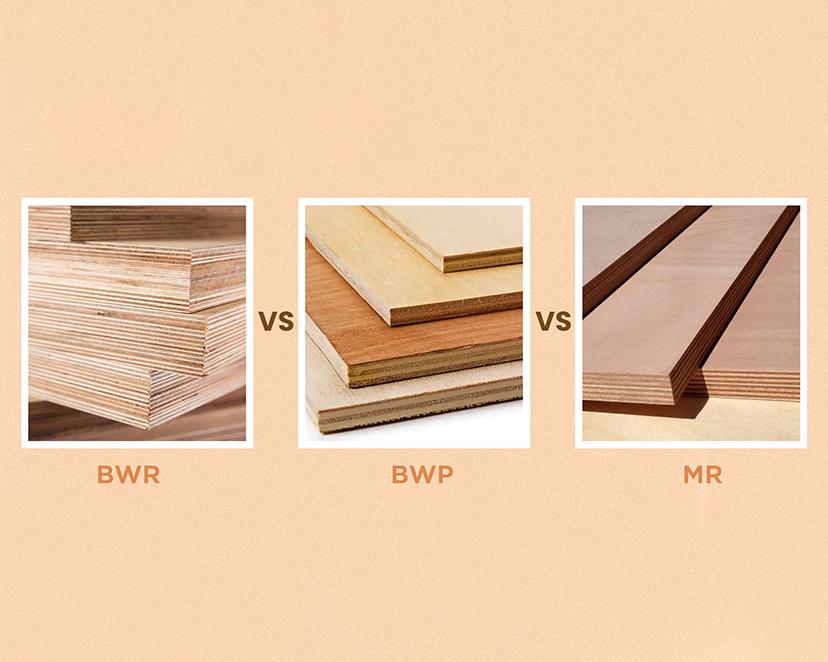
When you compare bwp vs bwr vs mr plywood, the major difference is water resistance and durability. BWP, or boiling waterproof plywood, has the greatest resistance to wet environments (kitchens, bathrooms). BWR, or boiling water resistant, plywood has a moderate degree of moisture resistance and is best used in semi-wet areas. Mr, or moisture resistant, plywood is intended for interior dry areas with very little exposure to moisture. BWP is the most durable, followed by BWR; MR is the least durable and is also the most inexpensive, but has the lowest moisture resistance. This makes bwp vs bwr vs mr a critical comparison.
Understanding Plywood Grades in India
Before looking into bwp vs bwr vs mr, it is worthwhile to find out why these grades exist in the first place. Indian Plywood is classified according to the following
- Water Resistance
- Bond strength of the adhesives
- Durability under environmental conditions
- Intended Use of Plywood
The ISI standard provides the grades of plywood according to moisture resistance: MR (IS 303) - medium moisture resistant, BWR (IS 303) - exterior grade BWR, and BWP (IS 710)- marine ply are the three overall grades used to classify plywood based on performance with respect to moisture. Knowing how these grades compare in bwp vs bwr vs mr plywood will determine how each grade will perform over the longer term.
BWP vs BWR vs MR: Core Differences Explained
When comparing bwp vs bwr vs mr plywood, the differences are not just technical; they directly impact how your furniture performs over time.
| Feature | BWP Plywood | BWR Plywood | MR Plywood |
|---|---|---|---|
| Water Resistance | Fully waterproof | Water-resistant | Moisture-resistant |
| Adhesive Type | Phenol Formaldehyde | Phenol Formaldehyde | Urea Formaldehyde |
| Ideal Usage | Bathrooms, kitchens | Semi-wet areas | Indoor dry spaces |
| Durability | Highest | Moderate | Basic |
| Cost | Premium | Mid-range | Economical |
This table simplifies the BWP vs BWR vs MR comparison, but each grade has deeper technical nuances.
1. BWP Plywood (Boiling Waterproof Grade)
What is BWP Plywood?
BWP plywood is known as marine-grade plywood, which is the highest quality plywood available in India. It is made with high-density hardwood and bonded with phenol formaldehyde adhesive, which provides waterproofing to this product.
Key Strengths
- Completely waterproof and boil-proof
- High load-bearing capacity
- Termite and borer-resistant
- Excellent dimensional stability
Applications
- Modular kitchen
- Bathroom cabinets
- Outdoor furniture
- Houses in the coastal region
According to the user, when comparing BWP vs BWR vs Mr Plywood, BWP plywood is best for conditions that require a high level of performance.
Why Choose BWP?
If your furniture will be exposed to frequent water contact, BWP plywood is a must because it does not swell, will not delaminate and provides long-term structural integrity in BWP vs BWR vs MR comparisons.
2. BWR Plywood (Boiling Water Resistant Grade)
What is BWR Plywood?
BWR Plywood can withstand occasional wetness, but it was not manufactured to withstand very wet conditions, and therefore, it has a less severe manufacturing process than BWP Plywood. They both use the same resin (Phenol Formaldehyde), but BWR Plywood does not have the same performance characteristics as BWP Plywood. When comparing BWR vs MR plywood, BWR plywood offers better water resistance and durability for semi-moist areas.
Key Strengths
- Offers good water resistance
- Durable in moderate humidity conditions
- Suitable for structural furniture applications due to its strength
- A cost-effective alternative to BWP Plywood
Applications
- Dry areas of kitchens (cabinets)
- Wardrobes
- Office furniture
- Dining room
Boiling water-resistant plywood provides an intermediate performance to cost balance when considered with MR & BWP plywood in BWP vs BWR vs MR evaluation.
3. MR Plywood (Moisture Resistant Grade)
What is MR Plywood?
Moisture-resistant plywood is made for indoor use where there is limited exposure to moisture. It uses Urea Formaldehyde resin, which makes it less moisture resistant than BWR and BWP. BWP's are built to withstand moisture and, therefore, are the next categories up in terms of expense and moisture resistance.
Key Strengths
Cost effective Lightweight Designed for use in dry interiors Is easy to work with
Applications
- Bedroom furniture
- Panels in Living Rooms
- Wall units
- Decorative pieces of furniture
When comparing MR, BWR and BWP, MR is the most inexpensive of the three types of plywood in BWP vs BWR vs MR plywood.
Detailed Comparison: Performance Perspective
When looking at bwp vs bwr vs mr grades of plywood, it's important to look at the actual performance of these products based on their names. Understanding the differences in MR vs BWP Plywood can also help homeowners choose the right material based on moisture exposure and durability requirements. The following will provide details of the differences between the three products.
Water Resistance Ratings
- BWP - will withstand boiling water for the long term.
- BWR - will withstand splashes or humidity.
- MR - will only withstand mild moisture.
Lifespan
- BWP - 15–25 years
- BWR - 10–15 years
- MR - 5–10 years
Cost vs Value
- BWP - high initial cost; very low maintenance costs.
- BWR - Mid-level cost provides good value.
- MR - Inexpensive to purchase, long-term will have much higher long-term maintenance costs.
By layering these comparisons of BWP, BWR and MR, including BWP vs BWR vs MR plywood, you can make the best decision for your project.
How to Choose the Right Grade
Deciding which plywood grade to purchase, whether it be BWP, BWR, or MR, is a matter of three primary decisions:
Location for Use
- Use BWP in wet conditions.
- Use BWR in humid to wet conditions.
- Use MR in dry locations.
Budget / Cost Planning
- Select BWP for the premium basis
- Select BWR for average value housing.ng
- Select MR for interior uses on a budget
Usage Duration / Longevity
- Use BWP if longevity and value are needed.
- Use BWR for moderate to average life
- Use MR when you are looking at temporary or decorative use
This structured thinking simplifies BWP vs BWR vs MR selection.
Common Mistakes to Avoid
Many buyers of plywood experience these common mistakes when trying to figure out which grade would work best for their needs
- Use of MR plywood for a kitchen area
- Assumption that BWR plywood is waterproof
- Failure to check for ISI certification
- Disregarding performance with price
Knowing and avoiding these common mistakes when making your purchase will help to keep your furniture looking nicer and performing better when choosing bwp vs bwr vs mr plywood.
BWP vs BWR vs MR in Indian Climate Conditions
In many regions across India, and based on their unique climatic conditions, the choice between bwp vs bwr vs mr is even more of an important decision:
Coastal Regions (Mumbai, Chennai)
where the humidity is always high, and BWP would be the right plywood grade to use.
Northern Regions (Delhi, Punjab)
Where there are wet and dry seasons, you would use BWR.
##Desert Regions (Rajasthan)
Where no moisture would exist, you can generally use MR plywood.
Choose your plywood based on your local climate so that you will have confidence in choosing your plywood with bwp vs bwr vs mr plywood clarity.
Conclusion
Choosing the plywood (BWP, BWR, and MR) is not just a technical decision, but rather a long-term investment in the durability and safety of your home. All the different grades of plywood can be used for specific purposes, and using the incorrect grade will cause damage to the product and lead to continued repairs of the same product.
Royale Touche provides an extensive range of premium quality plywood, including Boiling Waterproof Plywood, Moisture Resistant Plywood, and Marine Plywood, all manufactured specifically to meet the requirements of the Indian market. The choice you make based on bwp vs bwr vs mr can impact your furniture's durability, life expectancy, and confidence. Make a good choice today because the plywood you choose will not only support your furniture, but also support your quality of life.
Frequently Asked Questions
Is BWP, BWR or MR better?
BWP is the best grade for water resistance, BWR is the second best for water resistance, and MR has no water resistance, only moisture resistance and is suitable for dry conditions.
Can BWR be used for kitchens?
Yes, however, you should use BWR in areas with minimal exposure or water intrusion. BWP would be the proper plywood for wet areas.
Is MR plywood waterproof?
No, MR moisture-resistant only, and you should not use MR in areas subject to significant exposure.
Why is BWP plywood so expensive?
BWP plywood contains high-quality wood, excellent adhesive properties, and is 100% waterproof.
How do I know the BWP plywood I purchase is original?
You should check all conditions of the product specification and/or the manufacturer's claims are confirmed by IS710 Certification before you purchase.