
BWR vs MR plywood: Which One Should You Choose?
December 25, 2025
Table of Contents
Choosing the right type of plywood for your interior design project or commercial build is one of the biggest decisions you'll face. Unfortunately, many people are confused as to how to differentiate MR vs. BWR plywood. This confusion is caused by the many pieces of information available about these types of plywood and what can potentially go wrong if you choose the incorrect one: swollen cabinets, warped furniture, expensive repairs, and wasted money. Homeowners face the highest risk of suffering from moisture-related damage, and understanding the fundamental differences between MR and BWR plywood will enable you to make better-informed choices.
This guide assists you in simplifying the distinction between MR and BWR plywood and provides the background knowledge of MR plywood and BWR plywood that you need while making your final decision.
Before anything else, it is important to establish the basic definition of both MR plywood and BWR plywood and how these plywood grades perform in different ways.
What is MR Plywood?
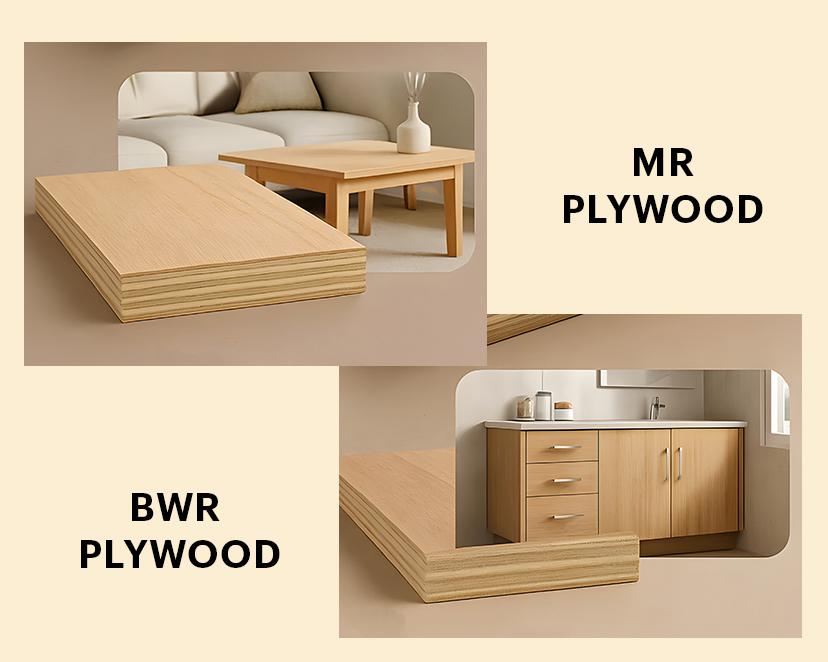
Moisture Resistant plywood is designed for indoor use where there may be some moisture exposure (such as bedrooms, living rooms, and offices), but it’s important to keep in mind that MR plywood is not considered “waterproof”. Therefore, if you are looking for quality protection against moisture or water damage, MR plywood offers a substantially lower level of protection than BWR.
What is BWR Plywood?
The abbreviation BWR stands for "Boiling Water Resistant". BWR plywood is manufactured with an advanced phenolic resin to provide superior waterproof capabilities. BWR plywood is suitable for use in areas that will experience extreme levels of humidity and/or wetness, such as kitchens, bathrooms, utility rooms, and terraces, and in areas that are likely to come into contact with exterior water sources. Therefore, you will notice that BWR plywood offers significantly better protection against moisture damage than MR plywood.
Comparative Analysis of MR vs. BWR Plywood
Understanding the major differences between MR plywood and BWR plywood is an essential element of making an informed decision in order to establish a durable space that will endure for years.
Waterproofing & Moisture Resistance
BWR can withstand occasional or constant exposure to boiling water and steam, as well as being in regular contact with moisture. This is the area where a significant difference in performance can be detected between BWR and MR plywood.
Structural Strength & Durability
While MR plywood has adequate structural strength for its intended applications (mostly for everyday use), BWR plywood has superior ability to carry loads and has long-term dimensional stability. Therefore, when comparing MR plywood with BWR, BWR clearly is superior for applications requiring a heavy-duty product.
Type of Adhesive Used
MR plywood is manufactured using UF (urea formaldehyde)-based resins (less expensive); BWR plywood is manufactured using PF (phenol formaldehyde)-based resins (higher quality), resulting in much stronger bonding between the layers. Therefore, the quality of the adhesives used in MR vs. BWR is a major determining factor in the performance of MR vs. BWR plywood.
Applications for Both MR and BWR Plywood
BWR is recommended for applications where contact with moisture will be encountered, such as kitchen cabinets, bathroom vanities, laundry rooms, outside seating areas, etc. In this regard, BWR plywood is the best alternative to MR plywood for applications involving regular exposure to moisture.
Cost Difference
MR plywood is less expensive than BWR due to the use of a less expensive adhesive and lower strength; however, the potential long-term cost savings can be significant in moisture-prone areas using BWR, as moisture will not develop and thus cause damage to the wood and, ultimately, the product; therefore, BWR will provide greater cost savings when taking into consideration the time period of use.
Lifespan
When used correctly for the appropriate applications, MR plywood has a longer lifespan than BWR plywood.
A Comparison Between Competitors
Alternative products must also be taken into consideration when considering the differences between MR plywood and BWR plywood.
| Material | Strengths | Limitations | Ideal Use |
|---|---|---|---|
| Marine / BWR Plywood | Extremely waterproof | High cost | Outdoor use, bathrooms, severe moisture |
| MDF | Smooth finish, affordable | Poor moisture resistance | Decorative units, dry zones |
| Particle Board | Very cost-effective | Low strength | Temporary furniture |
| Solid Wood | Premium look | Expensive, can warp | Luxury interiors |
| MR Plywood | Best for dry interiors | Not waterproof | Wardrobes, TV units |
| BWR Plywood | Waterproof, durable | Slightly higher cost | Kitchens, balconies |
Advantages of Selecting the Proper Plywood
Regardless of your plywood needs, whether purchasing MR or BWR for either a residential or commercial project, by selecting the proper plywood, you will get:
-
Longer-lasting, durable products.
-
Lesser repairs.
-
Higher performance when exposed to water or high-humidity environments.
-
Increased safety / structurally sound.
The best practice with regard to the determination of MR Plywood and MR BWR Plywood will be to use MR Plywood in a dry room environment and BWR Plywood in a wet area environment. Professionals consistently offer that a clear comprehension of the differences between MR and BWR is key in preventing future damage to your structure.
Choose MR Plywood — If:
-
When your furnishings are designed for dry spaces.
-
When your finances are insufficient for BWR Plywood.
-
When creating furniture for closets or file cabinets.
Choose BWR Plywood — If:
-
When exposed to moisture/humidity.
-
When seeking long-term strength, durability, and performance of the product.
-
When constructing a kitchen or bathroom area.
Simply put:
MR = Dry areas or interiors BWR = Wet or Humid areas or interiors
The above process will assist you in determining the proper plywood to purchase.
Conclusion
Selecting the appropriate plywood is key to developing a strong, stable, and aesthetic interior over the life of the structure being constructed. Royale Touche Plywood has developed an extensive range of engineered plywood products designed for many different applications and provides products that satisfy your functional criteria as well as your design intent. You can discover the Royale Touche product line based on the intended application of your project, including dry and moisture-prone interior areas. By doing so, you can make choices that will provide both long-term durability and a desired appearance.
Frequently Asked Questions
Which Plywood is Best for Kitchens?
BWR Plywood: BWR is the best option as it is water-resistant.
Is MR Plywood Waterproof?
No; MR Plywood is moisture-resistant but not waterproof. It is important to understand this when considering purchasing MR and BWR plywood.
Which Plywood Will Last Longer?
BWR plywood will typically last longer because of its superior bond and waterproofing capability.
Is MR Plywood Good for Wardrobes?
Yes, MR Plywood is the best option for all of your furniture needs that will be used in a DRY environment.
Is BWR Plywood Worth More than MR?
Yes, for kitchens and any other room that is going to see a high volume of water and/or moisture, they should be protected against damage by using BWR plywood, thus offering you better long-term value when considering MR vs BWR plywood.