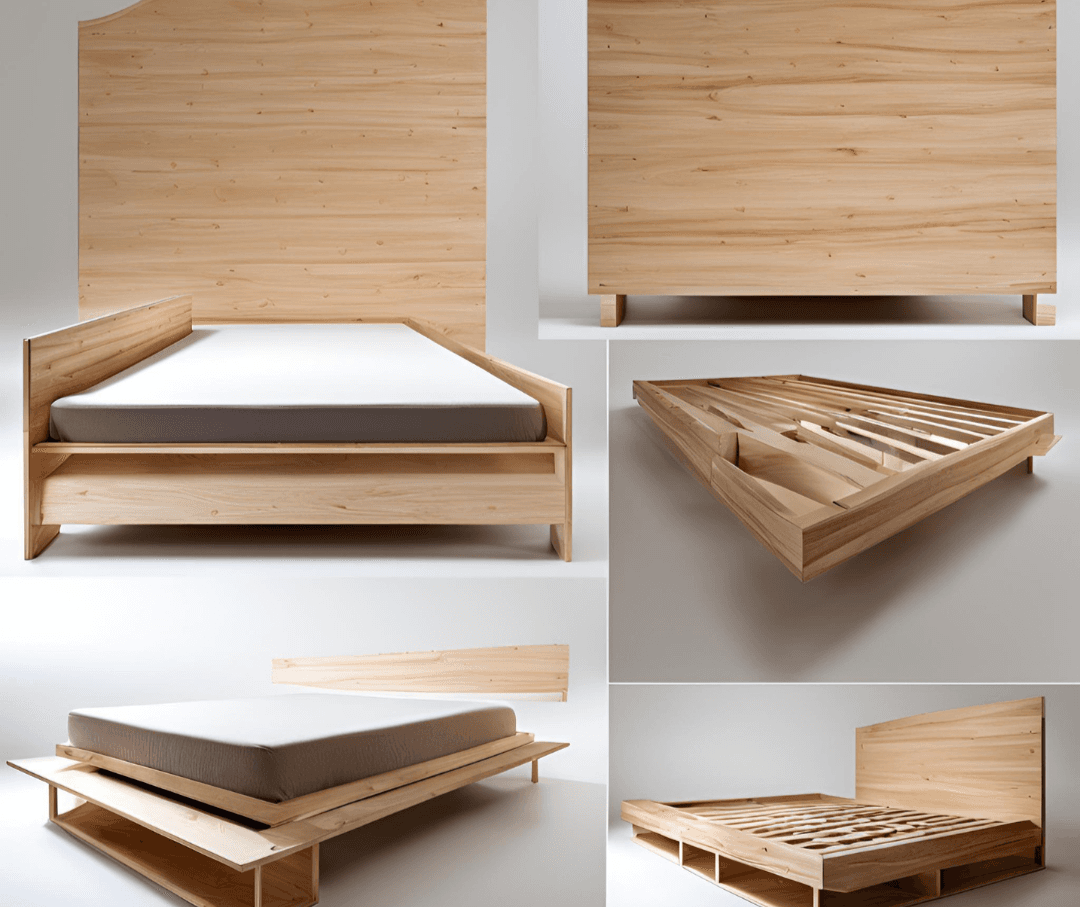
Which Material is Best for a Bed Frame? Plywood vs MDF vs Solid Wood Compared (2026 Guide)
October 19, 2026
Table of Contents
The best material for a bed frame in most Indian homes is BWP or BWR plywood, or well-seasoned solid wood such as sheesham or teak. Plywood gives strength and stability at a fair price, while solid wood suits premium, long-lasting beds. MDF works for headboards and decorative panels, not for load-bearing rails.
The right choice still depends on load, room humidity, design, budget, and build quality. Below, we compare plywood, solid wood, MDF, particle board, blockboard, HDHMR and metal so you can choose with confidence.
What Are Beds Made Of?
Beds could be manufactured from plywood, solid wood, MDF, particle board, blockboard,d and metal. The decision depends on the type of bed, its load requirements, expected lifetime, and budget.
Solid wood beds are a good choice as they are constructed from wood species including sheesham, teak, mango,ngo or pine. Modern bed frames, platforms and storage beds are popular with plywood because it is strong and stable. MDF and particleboard are commonly used for decorative elements or those parts that bear lower loads, while blockboard can be helpful in covering longer spans. Metal is another option if you want a thin, rigid frame.
That is why it is important to know which materials are used for the bed frame before choosing a material just for the appearance or price.
Engineered Wood vs Plywood: What Is the Difference?
Plywood is an engineered wood product. Engineered wood is a generic broad term for wood-based products which are manufactured by binding or compressing veneers, fibres, particles or strips of wood.
The Main Types of Engineered Wood
Plywood
Made by bonding together multiple layers of wood veneer. It has excellent strength and dimensional stability.
Blockboard
Constructed of wood strips faced with veneers. Good for longer span applications.
MDF
It is made from refined wood fibres compressed with resin. Its surface is smooth and even.
Particle Board
Wood particles and resin glued together. It’s generally an economical option.
HDHMR
A dense engineered board intended to have improved moisture resistance and strength over normal MDF.
In Simple Terms
Engineered Wood is a broad term and covers the following
- Plywood
- Blockboard
- MDF
- Particle Board
- HDHMR
These are not mutually interchangeable materials. They differ in strength, water resistance, screw-holding capacity, weight, and durability depending on the processes used in their manufacture.
Plywood for Bed Frames
Plywood is made from several layers of wood veneer glued together, the grain of the layers running in different directions. This construction provides plywood with good strength and dimensional stability.
Different options like BWP plywood, MR plywood, and calibrated plywood are required for different applications.
Strengths
- Good strength for structural uses
- Good dimensional stability
- Available in various grades and thicknesses
- Suitable for humid conditions when BWP/BWR grade is used
- Great for frames, platforms, and storage beds
Weaknesses
- Edges might need to be finished
- Quality varies widely by grade and construction
- Best For: Bed frames, platforms, storage beds, headboards & upholstered beds.
Solid Wood for Bed Frames
Different types of wood offer different combinations of strength, weight, durability, appearance, and price. Therefore, the species choice is important when choosing solid wood for a bed.
Sheesham Wood
Sheesham is a dense hardwood used often for furniture in India.
Strengths
- Great strength and durability
- Dense and ideal for heavy furniture
- One-of-a-kind natural grain
- Suitable for luxury and traditional beds
Weaknesses
- Heavyweight
- Can be a little expensive
If not properly seasoned, can expand, shrink, or crack with humidity changes. If you are wondering what sheesham wood is, it is a hardwood that comes from the Indian rosewood tree (Dalbergia sissoo).
Best for: Premium, strong, and traditional beds.
Teak Wood
Teak is a strong, stable, moisture-resistant hardwood. It is also valued for its appearance and durability.
Strengths
- Tough and durable
- Good dimensional stability
- Naturally more moisture-resistant than many other woods
- Long life with good maintenance
Weaknesses
- Costly
- Heavy
- Using premium-quality teak can greatly increase the price of a bed
Best for: Premium, long-lasting bed frames where the budget is not as important.
Mango Wood
Mango wood is hardwood. It is commonly used in furniture. It provides reasonable strength and an appealing natural look at a typically lower cost than higher-end hardwoods such as teak.
Strengths
- Good strength for furniture
- Good cereals
- Usually less expensive than teak
- Ideal for solid wood furniture
Weaknesses
Not as hard or durable as high-end hardwoods such as teak. Requires proper seasoning Sensitive to humidity conditions
Best for: Mid-range solid wood beds where looks and value are important.
Pine
Pine is a soft, light wood that is often used for bed frames and furniture.
Strengths
- Bright
- Easy to handle
- Usually less expensive
- Good for basic bed frame designs
Weaknesses
- Gentler than sheesham and teak
- More likely to get dents and scratches
- Proper treatment may be needed for long-term durability
Best for: Basic, lightweight, budget-conscious bed designs.
Palochina Wood
The term palochina is most often associated with paulownia wood. It is light in weight and relatively low in density compared to many hardwoods.
Strengths
- Light as a feather
- Good where the weight of the furniture is an issue
- Easy to work with and manage
Weaknesses
- Less dense than most hardwoods
- Not the first choice where the most strength in structure is needed
- The design and joinery are very much to do with the suitability
Is palochina wood good for bed frames? For properly designed lightweight bed frames, it can be suitable, but for heavily load-bearing components, denser hardwood or structurally suitable plywood may be more practical.
Which Wood Should You Choose?
Teak or well-seasoned sheesham can be a good choice for a premium and long-lasting bed. Mango wood provides a balance of looks and price, while pine is a good option when reduced weight and low cost are more important considerations. Palochina is more suitable for lightweight applications and should not be automatically considered the strongest bed-frame material.
MDF for Bed Frames
MDF is a smooth and even engineered board that is easy to paint, laminate and machine. It is generally cheaper than good quality solid wood.
Strengths
- Even and smooth surface
- Simple to paint or laminate
- Machinable
- Cheap usually
Weaknesses
- May expand upon contact with moisture
- Poor screw-holding under high stress
- Heavy for its size
Best Use: Headboards, decorative panels for dry rooms.
Do Not Use: MDF for the main material of heavy load-bearing rails or platforms.
Other Engineered Wood Options
Particle Board
Particle board is one of the more economical engineered-board choices.
- Strengths: Cheap, light, and good for selected low-load furniture.
- Weaknesses: Not as strong as plywood, poor resistance to moisture, and less suitable for structural elements under heavy loads.
Best for: Budget furniture and light-duty applications.
HDHMR
HDHMR is a dense engineered board, engineered for superior moisture resistance and strength over standard MDF.
- Strengths: Tight design, improved moisture resistance over standard MDF, and a smooth surface.
- Weaknesses: It is not yet a universal replacement for plywood for all structural applications, and the right grade must be chosen for the intended use.
Best for: Furniture parts that need a dense, moisture-resistant board.
Blockboard
The Blockboard has a core of wood strips, covered with veneers.
- Strengths: For longer spans and relatively stiff panels.
- Weaknesses: Performance is dependent on the quality of the core, the construction,n and the support. Best for: Platforms, headboards,ds and other longer pieces that are adequately supported.
Metal Bed Frames
Steel and other metals are also commonly used for bed frames. They can give high structural strength and allow for relatively slim frame designs.
- Strengths: Strong, rigid, durable,ble and good for minimalist designs.
- Weaknesses: Different visual appearance from wood, can look less warm visually, and needs proper protection against corrosion where needed.
Ideal for: Contemporary, minimalist, and industrial-style beds.
Bed Frame Material Comparison
| Factor | Plywood | Solid Wood | MDF | Particle Board | Blockboard |
|---|---|---|---|---|---|
| Strength/load | High | High | Medium | Low to Medium | Medium to High |
| Moisture resistance | Medium–High | Medium–High* | Low | Low | Medium–High |
| Termite resistance | Depends on product/treatment | Depends on species/treatment | Depends on treatment | Depends on treatment | Depends on treatment |
| Risk of warping | Low to Medium | Medium* | Low in dry conditions | Medium to High | Medium |
| Screw-holding | Good | Good | Moderate | Moderate–Low | Good |
| Lifespan | High | High | Moderate | Moderate | High |
| Cost | ₹85–₹260 / sq. ft. | ₹672–₹8,400 / CFT (Cubic Feet) | ₹47–₹87 / sq. ft. | ₹31–₹62 / sq. ft. | ₹62–₹118 / sq. ft. |
| Thickness/type | 25 mm; varies by grade | Varies by species; not directly comparable per sq. ft. | — | — | — |
| Best for | Frames, platforms, panels | Premium frames | Decorative panels | Budget furniture | Long panels |
The performance of solid wood depends on the species, seasoning,g and treatment.
Current plywood prices are available on the Plywood Prices page. Actual prices vary by grade, thickness, location and supplier.
Plywood vs Solid Wood: Which Should You Choose?
Plywood vs. wood strength is relative to the direction of load and type of load. Plywood is made of wood cross-layered to make it tough, and it gives good dimensional stability. Solid wood is strong along the grain.
Select Plywood If:
- You want a modern bed that is strong and stable.
- The bed will be subjected to humidity.
- You require various thickness and grade options.
- You are making a storage bed or an upholstered bed.
- You want good performance for a reasonable price.
Select Solid Wood If:
- You want the look of wood.
- You prefer premium or traditional furniture.
- You want a heavy, strong frame.
- Weight is not a major concern.
- You are willing to pay for good timber.
The question of what is the best wood for a bed frame does not have a one-size-fits-all answer. Strength, budget, appearance, weight,t and environmental conditions all determine the right species.
Best Material by Situation
| Situation | Recommended Material |
|---|---|
| Humid or coastal city | BWP/BWR plywood |
| Budget bed | MR plywood in dry rooms |
| Storage/hydraulic bed | BWP plywood, blockboard |
| Premium/heirloom bed | Solid wood |
| Upholstered bed | Base in calibrated plywood with foam and fabric |
| Kids' room | E-0 plywood (low formaldehyde emission) |
The material should still be selected according to the entire bed construction. Thickness, supports, joints, and hardware can all be significant factors in the final result.
Best Material for a Double Bed Frame
The double bed frame has to support the weight of the mattress, sleepers, and any extra load from movement or storage components. With proper design and support, both plywood and solid wood can work well.
A modern double bed can be practically designed with strength, stability,y and design flexibility by using appropriately graded plywood. Solid wood is another excellent option for a natural, premium look.
For grade, thickness, and support tips, read our guide on plywood for a double bed.
How to Check the Quality of Bed Frame Material When Purchasing
Before buying, look at the material and the finished construction.
ISI/IS mark
Check for the relevant standards and certifications.
Glue-line quality
Plywood layers should be well bonded with no visible separation.
Edges
Check for gaps, voids, or poor bonding.
Thickness
Ensure the sheet thickness is uniform.
Warranty
Check the product specifications and the written warranty.
For solid wood, enquire about species, seasoning, and moisture conditions. Proper treatment of the timber is important, as natural wood is less likely to warp, crack, or change shape as the moisture content changes.
Conclusion
Which material is best for bed frame construction is a question with many answers. Well-seasoned solid wood is good for high-quality and traditional beds, but plywood is a good choice for many modern beds because of its strength, stability, and versatility. MDF and particle boards are good for decorative or low-load applications. Ultimately, the best material will depend on the load, environment, design, budget,t and expected life of the bed.If you choose plywood for your bed, Royale Touche plywood offers options to match your design, load, and budget.
Frequently Asked Questions
1. Which is the best material for a bed frame?
Many homes use good quality plywood or well-seasoned solid wood. Plywood is sturdy and flexible; solid wood is authentic and tough. The best choice depends on the design of the bed, the expected load, the room conditions, the budget, and the construction quality.
2. Is MDF Better than Plywood for a Bed?
In the MDF vs plywood debate for bed frames, plywood is generally more suitable for structural elements because it has better structural performance and holds mechanical fixings more reliably. MDF is suitable for headboards and decorative parts in dry rooms, but it is usually not the first choice for heavily load-bearing parts.
3. What’s the Difference Between Engineered Wood and Plywood?
Engineered wood is a generic term for a variety of manufactured wood products. Plywood is engineered wood. Other examples include MDF, particleboard,d and HDHMR. These materials have different manufacturing processes and result in different properties in terms of strength, moisture resistance, stability, and finishing. Learn more in our engineered wood vs plywood comparison guide.
4. Can You Use MDF for Bed Frames?
MDF can be used for some bed components, especially decorative headboards and panels, in dry conditions. Not generally recommended as a main material for heavily loaded rails or platforms. Moisture can cause swelling, and its fixing performance is less suitable for highly stressed structural joints.
5. Solid Wood vs. Plywood for a Bed – Which is Better?
Neither is objectively better than the other. Solid wood is natural-looking and long-lasting. Plywood is dimensionally stable and versatile. Plywood is uniform in panel construction. Solid wood is heavier and more expensive. The right choice depends on the design, the environment, the quality of the material,and the budget. Learn more in our plywood vs solid wood comparison blog guide.
6. What Type of Engineered Wood Is Best for a Bed?
Plywood is a versatile engineered-wood alternative for a bed that provides a good balance of strength and dimensional stability. If there is more exposure to moisture, BWR or BWP grades may be considered. The grade and thickness to be used should be chosen to suit the particular design of the bed.

Related Blogs