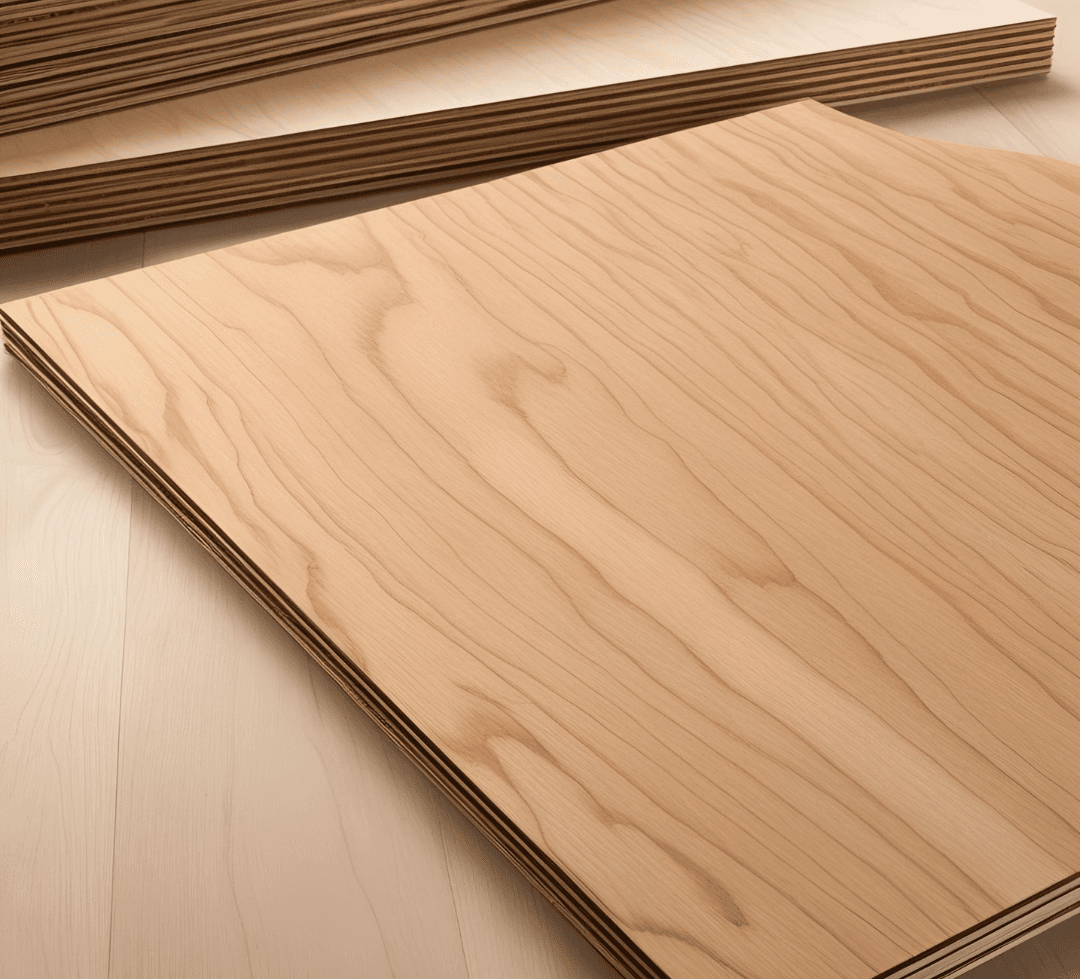
What Is Engineered Wood? Difference between Types of Plywood and Uses
October 21, 2026
Table of Contents
Engineered wood is a manufactured product made from wood veneers, strands, particles, or fibres bonded together with adhesives and processed under heat and pressure. It is uniform in dimension and may be used for a variety of furniture, decorative, or structural uses. Plywood is one of the engineered woods, together with MDF, particle board, blockboard,rd and HDHMR. The right material to be used depends on what it is used for. Different types have different properties, costs, and moisture resistance.
What Is Engineered Wood?
What is engineered wood? It is a wood-based product made by bonding wood elements together with adhesives to form boards, panels, or structural products with specific performance properties.
Engineered wood is created by using processed wood pieces which are arranged or compressed into a specific structure, while solid wood is cut directly from the trunk of a tree. Depending on the product,these can be thin veneers, strands of wood, chips, or fine fibres.
The main goal is to obtain an efficient utilisation of wood resources for the production of materials of uniform size and properties. Engineered wood is often sold in large sheets and is useful for furniture making, interior design and building work. Some are cheap and good for decorative work. Others are for strength or structural use.
How Engineered Wood Is Manufactured
The methods used to make engineered wood will vary depending on the type of engineered wood product. However, all types of engineered wood will generally require four steps in their production.
Raw Material Preparation
Timber or wood waste is selected and prepared before processing.
Wood Splitting: The wood is divided into veneers, strands, chips, particles, or fibres, according to the final product.
Adhesive Application
The appropriate adhesive is applied to glue the wood products together.
Pressing & Finishing
The wood is pressed into boards or sheets, then cut, finished,d and checked for quality.
Manufacturing Differences
Plywood manufacturing means the whole process of layering thin sheets of veneer, whereas MDF is manufactured by compressing wood shavings.
Engineered Wood Types
The main types of these differ in construction, strength, finish, and suitability for particular applications.
| Type | Material | Key Features | Common Uses |
|---|---|---|---|
| Plywood | Right-angle glued layers of thin sheets of wood | Different grades available. It’s strong and stable. | Cabinets, beds, kitchens, furniture |
| Blockboard | Wood strips with veneer faces | Good for long components, relatively light. | MDF doors, shelves and tabletops |
| MDF | Resin-bonded fine wood fibres | Smooth, uniform surface. Easy to paint. | Decorative panels, mouldings and doors |
| Particleboard | Wood chips, shavings and particles bonded by resin | Cost-effective and suitable for light-duty applications | Furniture and storage units (low budget) |
| HDHMR | Dense wood fibres glued together with appropriate resins under pressure | Higher density, better moisture resistance than standard MDF (product dependent) | Decorative panels, kitchen units, wardrobes |
| OSB | Wood fibres bonded with resin | Used in some structural and panel applications | Sheathing, subfloors and construction |
| LVL, glulam & CLT | Veneer or timber layers bonded together | Designed for specific structural needs | Beams, columns, floors and structures |
What Is Engineered Hardwood?
What is engineered hardwood? Engineered Hardwood Flooring is a product that generally features a thin veneer of real hardwood glued to a core of plywood or other engineered wood products. This is different from solid hardwood flooring, which is made of solid wood boards all the way through.
It is often used for flooring as the layered construction can be more dimensionally stable than solid wood in response to changing conditions indoors. Product-specific installation and moisture tolerance requirements.
Advantages and Disadvantages of Engineered Wood
Engineered wood has many practical advantages, but its performance is dependent on the type, grade,e and quality of manufacture.
Advantages
- Dimensional Consistency: Sheets are manufactured in consistent and predictable sizes and thicknesses.
- Efficient Use of Material: Some products use smaller pieces of wood and wood waste.
- Design Flexibility: Products are available for structural, decorative, and furniture applications.
- Pricing Options: Materials range from cheap particleboard to high-end structural products.
- Large Panel Sizes: Furniture is easy to manufacture and install in sheet form.
Disadvantages
- Moisture Sensitivity: Regular MDF and particle board will take on water and expand. Other products are less prone to moisture.
- Different Strength: Some man-made boards are not suitable for heavy loads or structural use.
- Limitations: Screw holding performance depends on material, density, thickness and edge distance.
- Repair Difficulty: Swelling or damage to the boards may be difficult to repair, especially if the core has gone bad.
Engineered Wood Applications
Engineered wood is used in residential, commercial,l and construction projects, with different products for different requirements.
Furniture
Bed frames, tables and cabinets are made extensively from plywood. MDF and particle boards are fine for certain furniture designs.
Closets
Carcasses, shutters & decorative parts available in Plywood, MDF & HDHMR depending on design & exposure. Check out our guide to the best plywood for wardrobe.
Kitchens
Material choice depends on exposure to moisture, cabinet construction, and placement of each element. Kitchen Cabinets Plywood.
Doors
Several door constructions are suitable for use with plywood, blockboard, and MDF. See our Guide to Plywood Options.
Flooring and Construction: Engineered hardwood flooring, OSB, LVL, glulam, and CLT all have different flooring or construction applications based on the specifications.
Is Plywood an Engineered Wood?
Plywood sheet are a engineered wood product, but the two words are not interchangeable. Engineered wood is an umbrella term and plywood is a type of engineered wood.
Plywood is manufactured by gluing together plies of wood with various grain directions to produce a sheet of balanced wood with uniform strength and good dimensional stability.
There are two other types of engineered boards, MDF and particle board, made up of compressed fibres and chips bonded together with adhesives. They tend to be fairly uniform in their structure and so make good options for some decorative products and furniture.
When thinking about what engineered wood is made of, consider the single board and not the assumption that all types are made of the same things.
Choosing Between Plywood and Other Engineered Board Types
Plywood
Use plywood for furniture parts where you need good strength, reliable screw holding, and a grade suitable for moisture conditions.
MDF
Consider MDF for smooth, painted decorative panels for dry interiors.
Particleboard
Cheap furniture for use in dry areas.
HDHMR
Think about for dense, smooth board with better moisture resistance where needed. See manufacturer specifications.
Structural Engineered Products
Only use structural engineered products such as LVL or CLT if specified for the intended construction use.
Is engineered wood and plywood the same?
Plywood vs. engineered wood Are they the same? It’s a wordplay thing. Plywood is one of the engineered wood products. But there are many other products that have different compositions and uses
Conclusion
Engineered wood is a generic term for a wide range of manufactured woods, for different purposes. Plywood, MDF, blockboard, particle board and HDHMR differ in construction, strength, moisture resistance and cost. Understanding these differences helps you to select the right material for furniture, interiors, or construction. Narrow down product options or locate a store to support your project by shopping the Royale Touche plywood collection or using the store finder.
Frequently Asked Questions
1. Is Engineered Wood and Plywood the Same?
No, they aren't the same. Plywood is a manufacturing method that involves glueing and stacking many sheets of wood in an organised fashion. Other materials such as MDF, particleboard or blockboard are part of the family of engineered wood.
2. Engineered Wood vs Plywood Which One is Better?
This is not an easy question to answer. Plywood is great for furnishing if you want something solid and robust. When working with MDF, however, you will have no difficulties in creating a smooth and glossy surface. Ideally, pick materials that are appropriate for the particular application.
3. What Does Engineered Wood Mean?
There is a wide range of components used to produce engineered wood. The most common series of materials is glued together wood veneer, wood strands, wood chips, wood particles, or wood fibres. The composition of engineered wood depends on the material used, as in plywood, the veneer, while MDF is mainly made up of wood fibres.
4. Can Engineered Wood Handle Water?
Not so much. MDF and particleboard will both swell if they get wet. Some types of plywood and engineered wood can be treated to be more resistant to exposure to water, but it takes a lot of effort.
5. Is Engineered Wood Real Wood?
Yes, engineered wood is made from real wood, sometimes with glue and adhesives added. The wood materials are plywood veneer and MDF boards made from small wood fibres.
6. Which Type of Engineered Wood Is Good for Furniture?
Structural parts of furniture are made of plywood, but decorative details are made from MDF. Particleboard is also used in the manufacture of low-cost products.

Related Blogs