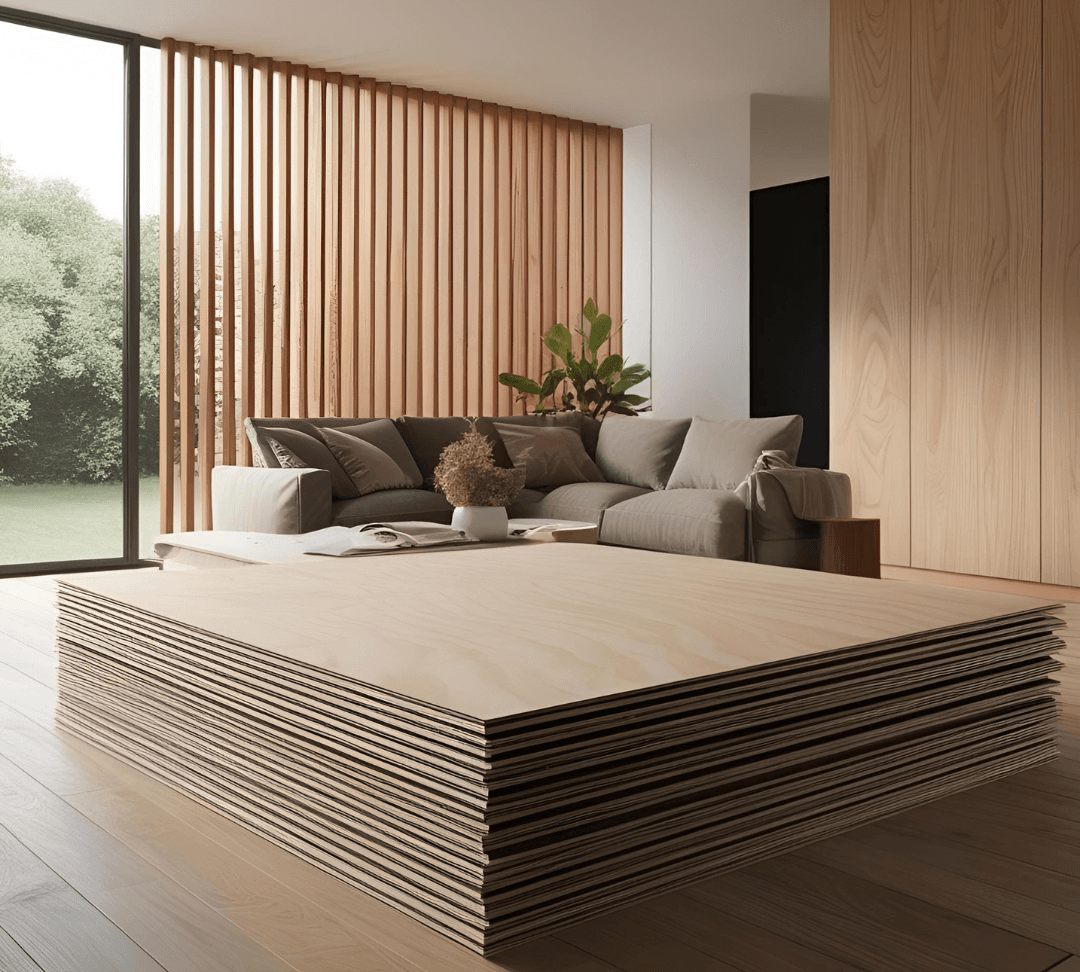
Plywood for Prefab & Modular Homes: Grades, Thickness & Applications

June 23, 2026
Table of Contents
In prefab construction, builders generally use Marine Plywood, Boiling Waterproof Plywood, Moisture Resistant Plywood and Fire Retardant Plywood depending on the application. In most projects, 18mm plywood is used for structural furniture and cabinets, 12-16mm plywood is used for panels and shutters, and 6-9mm plywood is used for wall cladding and back panels. It’s important to choose the right plywood for prefabricated homes because these homes are built in a factory and need materials that can survive shipping, installation, changes in moisture and long-term use.
Why Plywood Is Essential for Prefab & Modular Homes
Modular construction has revolutionised the design and construction of homes. Rather than building all the pieces on the site, today’s pre-fab homes are built in a controlled environment within a factory and shipped to the project site for assembly.
The method requires materials that are dimensionally stable, lightweight, easy to transport, and strong. This is why Plywood for prefabricated homes has become one of the most used construction materials in the industry.
Solid wood is less stable and more likely to warp than plywood. That makes it the better choice for factory-built modules, which have to fit together exactly during installation. Plywood for prefabricated homes is becoming popular due to its superior strength, durability and cost-effectiveness.
Understanding Plywood Grades Used by Builders
Not all grades of plywood are suitable for use in modular construction. Selection depends on the expected service life, structural requirements and moisture exposure.
Common Plywood Grades for Prefabricated Construction
| Plywood Grade | Application |
|---|---|
| Moisture Resistant Plywood | Interior furniture and dry spaces |
| Boiling Waterproof Plywood | Kitchens, utility spaces and structural furniture |
| Marine Plywood | Damp and demanding environments |
| Fire Retardant Plywood | Safety-critical applications and wall assemblies |
Opting for the right Plywood grade for modular homes ensures durability and reduces the need for future repairs.
Best Plywood grade for modular homes
Different grades are usually selected by builders according to the application.
Moisture Resistant Plywood
Moisture Resistant Plywood Used in low-moisture areas for wardrobes, shelving, wall panelling and furniture.
Boiling Waterproof Plywood
Boiling Waterproof Plywood is the best solution for kitchens, utility rooms and furniture subject to varying degrees of humidity.
Marine Plywood
Rated as the best Plywood grade for modular homes where long-term moisture protection is essential.
Fire Retardant Plywood
Increasingly specified on modern prefab projects where fire safety codes are of utmost importance.
Choosing the right Plywood grade for modular homes will improve the durability, structural integrity and security of the occupants.
Plywood thickness for prefab homes explained
The structural performance is sensitive to the thickness.
"Thinner plywood might reduce strength, but too thick panels add to the cost and weight."
Typical Plywood Thickness for Prefab Homes
| Thickness | Typical Uses |
|---|---|
| 6mm | Wall cladding, cabinet backs |
| 9mm | Partitions and lightweight panels |
| 12mm | Shutters and furniture panels |
| 16mm | Shelves / Wardrobes |
| 18mm | Kitchens / Cabinets / Structural Furniture |
| 19mm | Heavy Duty Modular |
| 25mm | Heavy Duty Structural |
Selecting the correct Plywood thickness for prefab homes is crucial for safety and durability.
Where Different Plywood Thicknesses Are Used
The thickness of plywood to be used will usually be dictated by the load requirements.
66 mm to 9 mm Plywood
Compatible with:
- Wall panelling
- Decorative finishing
- Cabinet supports
- Bottoms of drawers
12 mm to 16 mm Plywood
Uses:
- Shutters on wardrobe
- Panels for furniture
- Shelves Systems
- Interior wall systems
18 mm to 19 mm Plywood
For use with:
- Offal in the kitchen
- Wardrobes modular
- Parts of the structure
- Storage units
- Sedimentary structures
25mm Plywood
Application:
- Heavy-duty platforms
- Floor support systems
- Modular buildings for industrial use
Choosing the right Plywood thickness for prefab homes can prevent sagging, warping and premature structural failure.
Structural Advantages of Plywood in Modular Construction
The engineering properties of plywood make it a very good material for modular construction.
Excellent Strength to Weight Ratio
Plywood for modular homes provides great structural performance without unnecessary weight, making transportation easier.
Stability & Dimensional Change
The cross-laminated construction minimises expansion and contraction due to humidity changes.
Impact Strength
Plywood is tough to install and transport, resisting cracking and splitting.
Speedier Assembly
Large plywood sheets are quicker to install and increase construction efficiency. These benefits make Plywood for modular homes a popular choice among architects, builders and prefab manufacturers alike.
Why Builders Prefer Plywood Over Solid Wood
Solid wood looks good, but modular construction requires uniformity and accuracy.
Improved Dimensional Accuracy
Factory-made plywood has uniform thickness and predictable performance.
Reduced Material Waste
Larger sheet sizes make the best use of material.
Transport Made Easy
Plywood for prefabricated homes is lighter and easier to handle than solid timber panels.
Cost-effectiveness
Plywood gets you decent performance for a reasonable price.
This is one of the main reasons why Plywood for prefabricated homes still reigns supreme in modern modular construction.
Common Applications of Plywood for Modular Homes
Plywood for modular homes is a part of virtually every prefabricated construction today.
Structural Applications
- Wall constructions
- Floor boards
- Telhado de panelas
- Construction Divisions
Interior Applications
- Wardrobes
- Modular Kitchen
- Storage lockers
- Storage systems
Decorative Applications
- Cladding of walls
- Feature Panels
- Furniture surfaces
Plywood for modular homes is versatile and helps builders keep consistency throughout the project.
How to Choose the Right Plywood for Your Project
Things to think about when choosing Plywood for prefabricated homes:
Exposure to Moisture
Use Marine Plywood or Boiling Waterproof Plywood in wet areas.
Load Requirements
Thicker plywood for more loading applications.
Fire Safety Standards
Think about using Fire Retardant Plywood for added safety.
Reliability Over Time
Choose premium grades to reduce maintenance and replacement costs.
Choosing the right grade and Plywood thickness for prefab homes will ensure better performance throughout the life of the structure.
Why Royale Touche Plywood for Prefabricated & Modular Homes
Royale Touche plywood is specifically designed for the demanding needs of factory-built and modular housing.
Accurate Thickness Calibration
The uniform thickness allows the modular parts to be correctly aligned during assembly, reducing installation errors to a minimum.
High Holding Power of the Screw
Allows for multiple transport, assembly and daily use without hardware loosening over time.
Better Dimensional Stability
Built to withstand temperature and humidity fluctuations that are typically encountered during the transportation and installation of modular units.
Robust Structure Performance
Ideal for wall systems, wardrobes, kitchens, storage units and furniture integrated in prefabricated structures.
Long Service Life Protection from Moisture
Available in grades for severe service applications where resistance to moisture is important.
Reduced Risk of Warping During Transport
It will help keep it in shape and alignment, even when modules are moved long distances, if it has a good core construction.
These benefits make Royale Touche a trusted partner for builders looking for premium quality Plywood for prefabricated homes and Plywood for modular homes that are high on performance.
Conclusion
Choosing the right materials is what makes any prefab or modular project successful. Choosing the right Plywood for prefabricated homes, the right Plywood grade for modular homes, and the right Plywood thickness for prefab homes will directly affect structural stability, durability, installation efficiency, and long-term performance. One of the most important materials in modern modular construction is quality plywood, used in wall panels, kitchens, wardrobes or even structural systems. Premium-grade plywood allows builders to build strong, efficient and long-lasting prefabricated homes with the right thickness for the application.
FAQs
What kind of plywood is best for prefab homes?
Marine Plywood and Boiling Waterproof Plywood are usually the preferred choice.
What is the composition of the plywood of modular homes?
Marine Plywood, Boiling Waterproof Plywood, Moisture Resistant Plywood and Fire Retardant Plywood are common ones. So, the best Plywood grade for modular homes is determined by the application.
What is the thickness of plywood used for prefabricated houses?
The best plywood for modular kitchens, wardrobes, cabinets and structural furniture is 18 mm plywood.
Why Plywood over Solid Wood for Modular Construction?
Plywood is more consistent, more cost-effective, lighter and has better dimensional stability.
Can You Build A Complete Prefab House Using Marine Plywood?
Yes. Marine Ply is used for structural, furniture, et., where the best moisture resistance is required.
Do Modular Homes Need Fire Retardant Plywood?
Recommended for areas where enhanced fire safety is a priority.
How long will good plywood last in a prefabricated home?
Choose and take care of your quality plywood, and it will serve you well for years to come.

Related Blogs