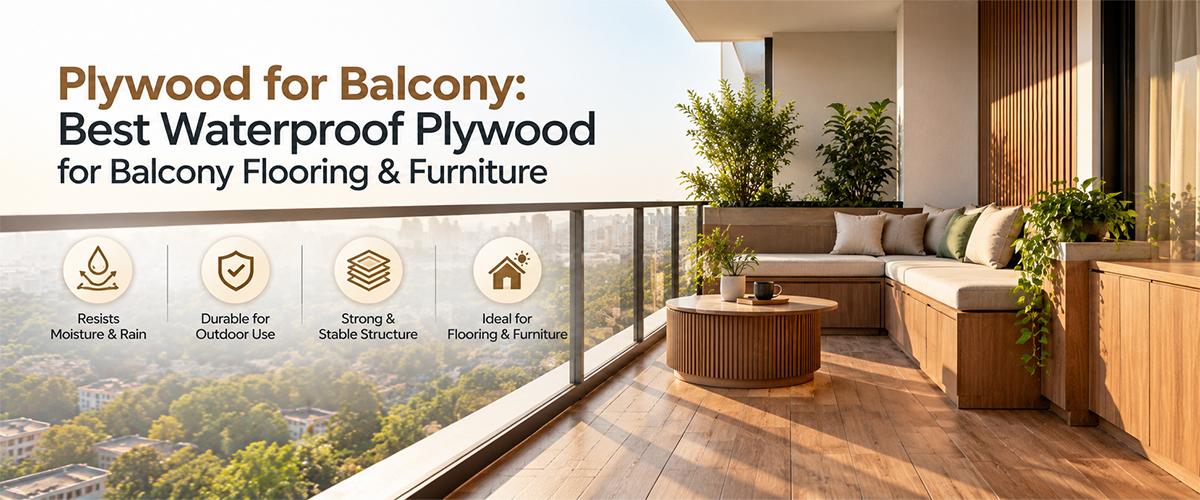
Plywood for Balcony: Best Waterproof Plywood for Balcony Flooring & Furniture
September 21, 2026
Table of Contents
Waterproof Plywood is generally the best option for balcony applications, especially for balcony furniture in covered or semi-covered balcony applications where the plywood is exposed to occasional moisture, humidity or rain. For balconies with more serious or prolonged moisture exposure, depending on the application and product specification, Marine Plywood can be considered. Moisture Resistant Plywood is a better choice for general interior applications with some moisture exposure.
The grade of the plywood alone doesn’t make a balcony waterproof. Proper waterproofing, drainage, raised installation, edge sealing and protection from standing water on plywood balconies are equally important.
A balcony is subject to things that indoor furniture typically is not. Over the years, plywood can be affected by rain, humidity, sunlight, condensation and sometimes water collection. So if you're buying balcony furniture or flooring, choosing the right waterproof plywood for the balcony is not as simple as picking a thick sheet.
The appropriate plywood grade should match the level of exposure, and the installation should be such that water does not remain on the plywood. This is particularly important when using plywood for balcony furniture, cabinets, benches, shelves or flooring.
This guide covers suitable plywood grades, thickness options and key considerations for using plywood on balconies. It also explains how exposure, waterproofing, drainage and protection can affect its performance.
Why Waterproof Plywood Is Important for Your Balcony
Plywood used in balconies may be subject to moisture from rain, humidity, cleaning water and condensation. Water can penetrate through exposed edges, joints, screw holes and damaged surface finishes.
Waterproof Plywood is more resistant to moisture than standard interior plywood. Generally, waterproof plywood is more suitable for balcony applications.
How Balcony Exposure Affects Plywood Selection?
The level of exposure is a vital factor in choosing plywood for balconies. Covered balconies tend to have less exposure to rain, while semi-covered balconies may experience some humidity. Open balconies can be more exposed to rain and sun, so it is important to choose the proper grade and way of installing plywood.
Suitable Plywood Grades for Balcony
BWP Plywood (Boiling Waterproof Plywood)
If you have a covered or semi-covered balcony, Boiling Waterproof Plywood is usually the practical choice. It can be used for cabinets, benches, shelves and other furniture that will be periodically exposed to moisture.
But for plywood balcony flooring, the balcony surface below must be properly waterproofed and drained.
Marine-Grade Plywood
Marine Plywood can be used for applications where the moisture conditions are more severe. It is designed for applications requiring higher moisture resistance, but the exact product specification and applicable standard should always be checked before selection.
MR Plywood
Moisture Resistant Plywood is designed for general interior use and limited exposure to moisture. Usually not the choice where plywood will be exposed to rain or outdoor moisture regularly.
Which Plywood Type is Appropriate for Flooring on Balconies?
Plywood can be installed as a balcony flooring material, however, it is essential to select the appropriate grade and the installation method. Weather conditions may dictate humidity, soaking, and water cleaning of a balcony floor, and hence plywood in this case must have moisture protection.
BWP (Boiling Waterproof) Plywood can be used as a flooring option for balconies that are safeguarded from direct exposure to rain, however, if the intended application requires a high level of moisture protection, Marine Plywood should be used. MR Plywood, on the other hand, is meant for interior applications with minimal exposure to moisture and is not recommended for balconies that will be exposed to rain frequently.
In order to properly install plywood:
- Find out the right thickness Plywood thickness should be determined by the distance between the supports and the anticipated load.
- Check for waterproofing Before installation, make sure that there is a waterproofing system under the plywood.
- Organize drainage Ensure that the new flooring does not accumulate water on or underneath the floor.
- Verify ventilation Make sure that air flows between the plywood layers for a better drying process.
- Seal joints and edges properly Make sure that joints and fixing points will be sealed tightly so that moisture can be reduced.
With a fully open balcony, more work is to be done regarding the moisture protector and the drainage system than with a covered or semi-covered balcony. Thus, the total flooring system must be chosen according to the amount of exposure.
Which Plywood Type is Appropriate for Balcony Furniture?
Plywood is suitable for balcony furniture manufacturing, examples of which may include benches, shelves, cabinets, and seating objects. The suitable plywood grade will depend on how much rain, humidity, and sunlight it is expected to receive.
For balcony furniture that is covered or partially covered, the best option would be BWP (Boiling Waterproof) Plywood, as it is expected to come in contact with moisture from time to time. However, for furniture that is exposed to moisture regularly, Marine Plywood should be installed based on the purpose of furniture and its requirements. MR Plywood is generally designed for indoor applications with limited moisture exposure, so it is not advisable to use it for outdoor furniture that is exposed to rain regularly.
In order to choose a suitable plywood type for balcony furniture, pay attention to the following points:
Moisture exposure
Select the right grade according to the amount of moisture that may be received by the furniture. Load requirements: Make sure to choose the correct thickness and to provide needed support for bench, shelf, and cabinet.
Edge protection
Make sure that the edges are sealed properly. Joints and hardware: Make sure that the construction methods and hardware fulfill the requirements of the furniture.
Ventilation
Check that there is enough airflow around the furniture.
Floor contact
When possible, raise the furniture higher above the floor. If the balcony is covered, the plywood grade may be waterproof only in the case of occasional moisture exposure. If the balcony is fully open, finish of the surface, edge protection, and design of the furniture become crucial.
Importance of Edge Sealing
Plywood edges are particularly vulnerable as moisture can find its way through exposed layers. Edge sealing is important to reduce moisture entry and help protect the plywood.
Sealing does not make plywood waterproof for life, however. Proper installation and protection are still key for long-term waterproof plywood balcony applications.
How to protect Plywood on Balcony From Rain and Sun
Keep Furniture Elevated
To prevent water from standing against the base, elevate balcony furniture just off the floor.
Create an Overhang
If possible, use balcony covers or appropriate overhangs to limit direct rain exposure.
Seal Edges
Seal exposed plywood edges, especially on furniture panels and flooring parts.
Avoid Water Traps
Design furniture and flooring to allow water to drain away, rather than collecting in joints and corners.
Keep Air Flowing
Sufficient airflow helps surfaces dry faster after contact with moisture.
Protect the Surface From Sunlight
For plywood that is subject to direct sunlight, it is best to apply an appropriate surface finish or protective coating as dictated by its use. This will afford the plywood adequate protection from the damaging effects of sunlight and weathering.
What Are the Common Mistakes to Avoid When Using Plywood on a Balcony?
Getting the best plywood is only one aspect of ensuring durability and functionality. Avoid these mistakes:
Wrong grade of plywood
The plywood's grade should be compatible with the balcony's degree of exposure to water and weather.
Overlooking load and support
Choose the thickness depending on what load it has to carry and the distances between its supports.
Not applying waterproofing
It is necessary to provide waterproofing and drain under the balcony flooring. Not covering edges: Be sure to seal edges, joints, and fastening points to keep moisture from entering.
Letting water accumulate
Be sure to avoid water standing on top of the plywood.
Placing furniture incorrectly
Plywood furniture should be raised off the balcony floor for better airflow to the plywood.
Not protecting the surface
Provide a suitable finish to areas of plywood that are subject to sunlight and the weather.
Choosing the Right Plywood for Your Balcony
Match the plywood to the real exposure-
| Balcony Application | Suitable Plywood Option |
|---|---|
| Covered Storage Cabinet | 16mm Waterproof Plywood |
| Balcony Bench | 16–19mm, depending on load |
| Balcony Shelves | 16–19mm, depending on span and load |
| Balcony Flooring | Thickness based on support spacing and expected load |
| Fully Exposed Balcony Flooring | Suitable waterproof-grade plywood with careful waterproofing and weather protection |
| Balcony Storage Unit | 16mm Waterproof Plywood |
| Balcony Seating | 16–19mm, depending on load and support |
| Decorative Balcony Panels | Thickness based on design and application |
When making the final decision, take into account the balcony's exposures, what it would be used for, the weight that will be placed on it, how far supports are apart, how it drains, and how much protection is needed. You may be able to use plywood made for covered balconies on ones that are fully exposed
What should I check before buying plywood for balcony?
Grade of Plywood
Look carefully at the quality of the plywood.
Applicable Standards
Look at the standards being used.
Core Composition
Ensure the plywood core is consistent. Presence of Gaps: Look to see if there are any gaps.
Quality of Bonding
Check that the plywood is bonded together properly.
Uniformity of Thickness
Ensure the thickness of the plywood is the same all over it.
Surface Treatment
Consider the treatment of the plywood surface. Protection Against Borers and Termites: Check if the plywood has protection from termites and borers.
Fasteners Quality
Check the quality of the fasteners.
Type of Environment
Make sure the plywood is right for the environment.
Conclusion
The selection of the right waterproof plywood for balcony use involves considering the plywood as well as the installation environment. Waterproof Plywood is generally used for covered and semi-covered balconies, and Marine Plywood can be considered for critical moisture exposure. Moisture Resistant Plywood is better suited for general interior uses where there is limited moisture. Regardless of grade, all balcony furniture and flooring needs good drainage, support, edge sealing, ventilation and underlying waterproofing to be durable.
Frequently Asked Questions
What Is the Best Plywood for a Balcony?
Typically, waterproof plywood is suitable for covered or semi-covered balcony applications. The use of Marine Plywood may be considered for more demanding moisture conditions.
Is Waterproof Plywood Good for Balcony Flooring?
Yes, but waterproof plywood balcony flooring needs good support, drainage, edge sealing, ventilation and waterproofing underneath.
How Thick Should Balcony Furniture Plywood Be?
It is good for many cabinets and furniture, but 19mm might be better for wider shelves, benches or heavier loads.
How Can You Enhance Waterproofing of Plywood Balconies?
Make sure there is good drainage, seal exposed edges, keep furniture off the ground, allow for airflow, and make sure the underlying balcony waterproofing system is working.
Can Regular Plywood Be Used for Open Balconies?
Interior plywood is normally not suitable for a balcony that is regularly exposed to the elements. Depending on the degree of exposure and application, Marine Plywood or Waterproof Plywood is more appropriate.

Related Blogs