Plywood Density Explained: How It Affects Your Furniture
September 9, 2026
Table of Contents
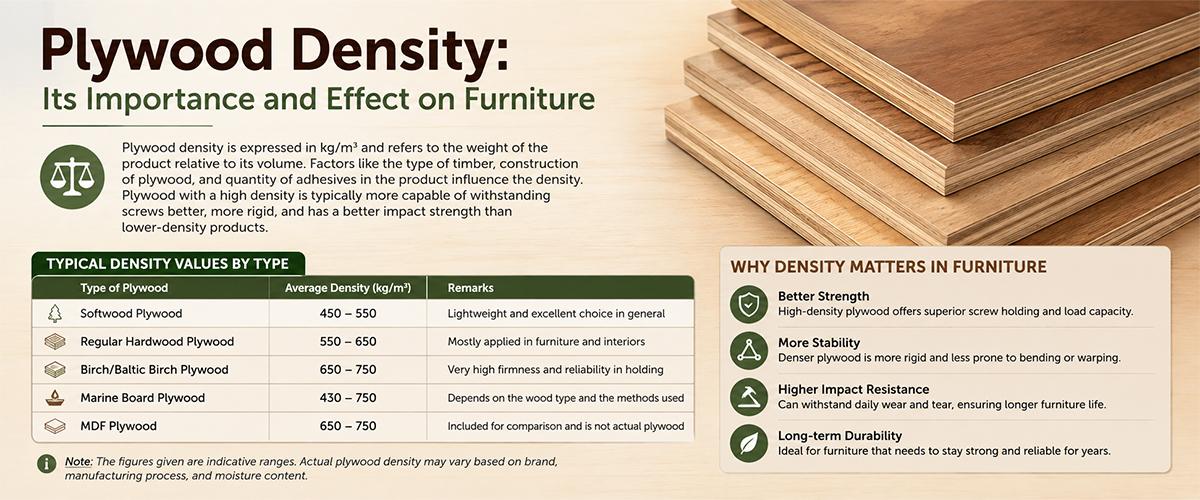
Plywood density is expressed in kg/m³ and refers to the weight of the product relative to its volume. Factors like the type of timber, construction of plywood, and quantity of adhesives in the product influence the density. Plywood with a high density is typically more capable of withstanding screws better, more rigid, and has a better impact strength than lower-density products.
When purchasing plywood for their furniture projects, most buyers think about the thickness, quality of grade, and price. However, plywood density is an important specification that is often overlooked, but that is key to how well the panel will perform in everyday use. If the density of plywood is chosen given the wrong parameters, it may cause issues like bowed shelves, unscrewed screws, or too heavy furniture.
Density is an essential factor that determines how much weight plywood has in its volume. Plywood density depends on wood species, number of layers, core material, and type of adhesive. Knowing plywood density meaning can help the buyer make a more sensible decision when buying furniture or its parts, such as bookcases, cabinets, wardrobes, and tables. The purpose of this article is to help the reader understand what density is, what affects it, how it relates to plywood grade, and how density is chosen for different furniture purposes.
What Is Plywood Density?
Plywood density is defined as the weight of plywood per cubic volume. It can be calculated in kg/m³, though lb/ft³ can also be used. The basic principles governing the subject are formulated in the equation.
Density = Mass ÷ Volume
In the case of a rectangular piece of plywood, the calculation of its volume is done through the product of its length, width, and thickness (length × width × thickness). Therefore, using the weight of the sheet obtained, if we divide that mass by the calculated volume, we shall get the approximate density of wood.
For a standard 8 × 4 ft plywood sheet, using 12 mm thickness as an example:
Sheet size: 2.44 m × 1.22 m × 0.012 m Volume: 2.44 × 1.22 × 0.012 = 0.0357 m³
If the sheet weighs 20 kg:
Density = 20 ÷ 0.0357 ≈ 560 kg/m³
So, a standard 8 × 4 ft, 12 mm plywood sheet weighing 20 kg has an approximate density of 560 kg/m³.
Density is a physical property of plywood, not a plywood grade or type. It should therefore be evaluated alongside the plywood’s species, thickness, core construction, grade, and intended application to understand its overall performance.
Factors Affecting Plywood Density
Type of Wood
The type of wood used in plywood is directly connected with its density. Hardwoods like oak and birch are typically denser than softwoods like pine and fir. Thus, two sheets of plywood that have the same dimensions can differ considerably in weight.
Plies and Bonds
The number of skins used and the way they are bonded have an impact on the general density of the plywood as well. The panel that is produced using a proper method of bonding will have a structure that is equal overall.
Thickness
Thickness relates to the overall weight of the plywood, while an automatic conclusion cannot be made that density is higher in this case. Density is a proportion of weight and volume, meaning that if the thickness of a sheet of plywood made from the same wood increases, its weight increases but density may remain the same.
Glue in Plywood
Glue contributes to the total weight of plywood, and glue type significantly influences the ply wood density of plywood mass. Cores that are strong and consistent will provide more consistent uniformity of material, while holes or hollow sections will decrease the density of the panel.
Plywood Density Table: Typical Values by Type
| Type of Plywood | Average Density Values (kg/m³) | Remarks |
|---|---|---|
| Softwood plywood | 450–550 | Lightweight and an excellent choice in general |
| Regular hardwood plywood | 550–650 | Mostly used in furniture and interiors |
| Birch/Baltic birch plywood | 650–750 | Very high firmness and reliable holding |
| Marine board plywood | 430–750 | Depends on the wood type and manufacturing methods |
| MDF plywood | 650–750 | Included for comparison; it is not actu |
Note that the figures given are not general features but merely indicative ranges. One should take into consideration that the actual plywood density may differ greatly depending on the kind of tree, method of manufacturing, dampness, adhesive and the company that has produced it.
Density vs. Grade vs. Strength
One of the main misunderstandings is that density and grade are synonymous terms. Actually, they are not.
Plywood density is a precisely measured physical property, while the grade indicates the quality of the surface, the presence of defects, the uses of a plywood sheet, and several other parameters. For instance, MR, BWR, and BWP grades represent the level of efficiency of a plywood board and should not be associated with density at all.
While purchasing plywood meant for manufacturing furniture with heavy loads, density, wood species, core design, strength features, and grade should be assessed in combination.
Importance of Plywood Density in Furniture Making
Screws and Fasteners Holding
It is well-known that thicker plywood has a better ability to resist screws pulling out and can hold bolts and nuts much better. This is very important in cases of making wardrobes, cabinets, and racks in furniture that need to be constructed and deconstructed frequently.
Resistance to Sagging
With long shelves and racks, the plywood density allows making a selection of materials that provide good stiffness and effective loading capacity. However, the sagging process depends on many factors: shelf length and width, thickness, number and type of supports, and the way the panels are made.
Resistance to Impacts and Wear
Panels with higher density are better at resisting everyday impacts, dents, and damage. This characteristic can be good for furniture items connected with frequent usage or handling.
Weight of the Panels
Higher density also means greater weight. While a thicker sheet can help to create more useful characteristics, this piece will be more challenging to carry and install. Thus, it may not be appropriate for all cases.
Water Resistance
Density can help make the plywood rigid and enhance some of its properties; however, density alone does not guarantee that the plywood will be water-resistant.
| Furniture Category | Recommended Density | Reason for Density |
|---|---|---|
| Bookcases and Heavy-Duty Shelving | High Density, at least 650 kg/m³ | Better for loads applied over time |
| Cabinets and Wardrobes | Moderate to High Density, 600–700 kg/m³ | Provides a balance between strength and weight |
| Side Tables and Room Dividers | Low to Moderate Density, 450–550 kg/m³ | Easy to carry and move around |
| CNC-Machined Furniture | High Density, 650–750 kg/m³ | Provides a consistently strong core and allows clean processing |
| Outdoor Furniture | Moderate Density, with adequate moisture treatment | Balances weight and exposure requirements |
It is vital to match the plywood density of your plywood not only according to the densest available but rather based on use, dimensions, structure of the furniture item, and its area of application.
How to Determine Plywood Density
The simplest way to determine the density of plywood before making an order is to ask the manufacturer about the sheet’s density specifications or its technical data sheet, as it is more trustworthy than guesswork.
One can also find out the plywood density by weighing the plywood sheet and calculating the volume as length * width * thickness, and dividing the value of the sheet’s weight by its volume. For example, when comparing two boards with similar size, thickness, and design, but a different weight, the density and moisture content must be checked. It is advisable to refer to the manufacturer’s specifications for clarification.
Conclusion
“Plywood density” refers to an important feature of plywood determining such properties as screw-holding capacity, weight, stiffness, and impact resistance. The measurement depends on wood type, thickness of plywood veneer, glue, and core.
Frequently Asked Questions
What Density Is Ideal for Plywood?
There is no universal answer. For most furniture applications, a density of 600 to 700 kg/m³ is acceptable, while heavy racks and CNC projects need better results.
Is Higher-Density Plywood Always Stronger?
Not necessarily. Density does impact the performance, but other characteristics also play an important role in plywood quality.
Is Plywood Density Related to Its Moisture Resistance?
Not really. Plywood's grade is more important than density when it comes to moisture performance.
What Is the Difference Between Density and Grade in Plywood?
Density is the weight of plywood per volume. Grade is among other parameters determining the plywood classification.
Why Is Birch Plywood Denser Than Pine Plywood?
Birch is a heavier type of hardwood than pine. Nevertheless, the actual density may depend on the manufacturer's data.
Is It Possible to Measure Plywood Density at Home?
Yes. You need to weigh the plywood board, calculate its volume using the length x width x height formula, and divide the result by the first one.

Related Blogs