
Particle Board vs Plywood: What is the Difference between Particle Board and Plywood?
January 13, 2026
Table of Contents
What Is Particle Board?
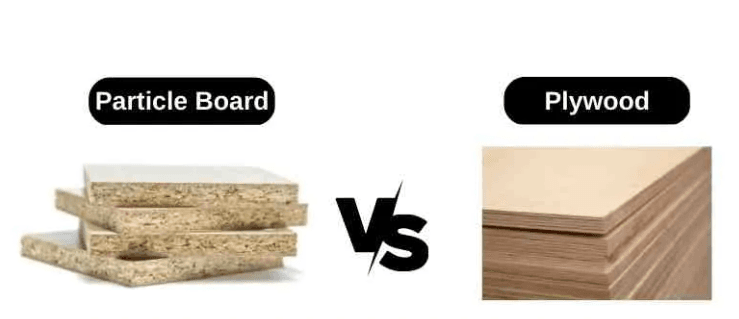
Particle board is made by using various sizes of wood particles (chips, sawdust, and small wooden pieces) that are glued together with resin and pressed into flat boards under high pressure.
Particle board is comparatively cheaper than plywood and has a smooth, flat surface. Particle board also weighs less than plywood, is easy to add a laminate finish to, and has a consistent grain pattern. This makes particle board ideal for making ready-made furniture, modular furniture, and temporary displays. On the downside, when comparing particle board vs plywood, particle board is weaker than plywood. It can absorb moisture and swell up, break with too much weight, and has limited strength to carry weight.
What Is Plywood?
Plywood is manufactured by bonding several thin layers of wood veneer using high-performance adhesives. The layers are oriented with alternating grain direction in a criss-cross pattern, giving engineered plywood the exceptional strength and stability of dimension.
When comparing the durability of particle board and plywood, plywood is much stronger, has a longer life span, and is more resistant to moisture and insects (termites) than particle board, making it an excellent choice for kitchens, wardrobes, elevators, stairs, and commercial use.
Royale Touche manufactures premium plywood utilising Southern Yellow Pine, Gurjan face veneers, calibrated cores, and engineered technology to prevent any wavy, warped, or sagged plywood sheets.
Particle Board vs Plywood: Key Construction Differences
The construction methods are the biggest distinction between particle board and plywood.
-
Particle board is constructed with waste materials from the manufacturing process of wood products.
-
Particle board has a consistent and lightweight build and is strong at an economical price.
-
Particle board only holds up to low-pressure application usages.
-
Plywood products are also constructed with many thin layers of thin sheets laminated together.
-
Plywood has high tensile strength and is very flexible; thus, it stands up better to the elements, moisture, and bugs, which are part of their everyday lives.
-
Plywood can be used in all circumstances but excels best as a long-term material for high-traffic utilisation.
Understanding how each type of material was made helps form the basis for nearly every major difference in how particle board vs plywood performs.
Strength and Durability
When comparing particleboard to plywood, strength becomes more important than the type of construction (particleboard has a thinner layer than plywood). Plywood will resist vibration, shock, and heavy loads without breaking. Particleboard can be used to make lightweight shelves, desks, display units, and decorative items. However, under moisture and pressure, it tends to expand and break. Additionally, this is one way of describing what the difference is between particle board and plywood. Plywood lasts longer than particleboard and therefore may be a more economical option for making furniture that will be used in an office or commercial environment.
Moisture Resistance
In humid areas such as kitchens or bathrooms, it is very important for products to be resistant to moisture. Again, particle board and plywood differ vastly when it comes to moisture resistance.
- Particle boards are made out of a material that absorbs water very quickly.
- The moisture will cause the board to swell and become deformed.
Because of this, particle boards are not an appropriate material for use in wet areas.
On the other hand, plywood products, especially waterproof and BWP-graded plywoods, have an extremely high performance level against moisture. They are chemically treated to withstand not only water but also termites and borers. Because of this, plywood products would be the preferred choice for the kitchen, sink area, utility room and outdoor exposed surfaces.
Weight and Workability
The weight of a material has an impact on its workability, and this is particularly true for particle board vs plywood.
-
A particle board is a lightweight material that is easy to work with and cut, it will require less effort to install.
-
Plywood is a heavier material than particle board and also provides greater strength and stability; therefore, it is able to provide a higher amount of structural support than particle board does.
In addition, cabinet hinges, screws, and other hardware hold better in plywood than in particle board because cabinets made from plywood will remain stable over time, whereas cabinets made of particle board will experience some degradation of the fastener over time due to the loose structure of the particle board itself.
Cost Comparison
While pricing is often the main determining factor when choosing a product, particle board offers a lower price than plywood, helping to maintain budget constraints when it comes to larger-scale projects or furniture builds.
However, plywood also provides a better return on investment, as it lasts significantly longer, does not warp over time and is vastly superior in terms of strength. Selecting plywood manufactured by a reputable brand, such as Royale Touche, will provide proof of durable and consistent quality and workmanship when using this type of material.
When consumers ask what the difference between particle board and plywood is, the majority of the time they will choose plywood after performing a cost-benefit analysis.
Aesthetic and Finish
Both materials can be nicely finished using laminate, veneer or paint.
-
Particle board has a very smooth surface and works well with laminate finishes, as it provides the perfect base for a laminate finish.
-
Plywood, on the other hand, provides a natural wood texture and has a premium-grade finish.
In general, when comparing particle board vs plywood for installation in luxury interior spaces, due to the warmth and richness of the natural wood, along with the overall elegance associated with real wood, plywood is the preferred choice.
Where to Use Particle Board
Particle board is recommended for temporary items or those that are lightweight:
- Bookcases
- Study tables
- Display cabinets
- Wardrobe doors in dry areas
The lower density of the material's structure makes it easier to handle; hence, the longer the particle board remains under stress, the greater the long-term structural disadvantages.
Where to Use Plywood
Plywood should be utilised where high strength and longevity are required:
- Kitchen cabinets
- Bedroom wardrobes
- Vanities in bathrooms
- Floors
- Partition walls and panels
- Staircases and platforms
- Commercial furniture
When evaluating particle board vs plywood, architects and interior designers favour plywood due to its superior stability, strength and weatherability.
Comparison Table: Particle Board vs Plywood
| Feature | Particle Board | Plywood |
|---|---|---|
| Material Composition | Made from wood chips, sawdust, and small particles bonded with resin | Made from multiple layers of wood veneer bonded cross-grain |
| Strength & Durability | Lower strength, can break under weight or stress | High strength, withstands shock, vibration, and heavy loads |
| Moisture Resistance | Absorbs moisture quickly, swells and deforms | Highly moisture resistant, especially BWP and waterproof grades |
| Weight | Lightweight and easy to handle | Heavier, provides higher structural stability |
| Workability | Easy to cut and install; screws may loosen over time | Holds screws and hardware firmly, retains structure over time |
| Cost | Cheaper and suitable for low-budget projects | Higher cost but long-term value due to longevity and performance |
| Aesthetic Finish | Smooth surface, suitable for laminate | Natural wood texture with premium finish |
| Recommended Usage | Temporary furniture, shelves, display units | Kitchens, wardrobes, flooring, stairs, commercial furniture |
| Longevity | Shorter lifespan | Much longer lifespan, excellent for repeated, heavy use |
| Ideal Choice For | Low-load and non-moisture areas | High-traffic, moisture-prone spaces and long-term applications |
Why Royale Touche Plywood Is Better
Royale Touche plywood is constructed with the following materials:
- High-density inner core
- Dual-calibrated framework
- 100% Southern Yellow Pine
- Gurjan exterior veneers
- Technologically climate-stability treatment
- Termite and Borer Treatment
The production methods used by Royale Touche highlight precision and unrivalled durability in plywood, making it the most premium-quality product available. Comparing particle board and plywood, Royale Touche plywood clearly stands out from others as the top premium brand of plywood for both residential and commercial installations.
Final Verdict: Which Is Better?
While there are benefits to both particle board vs plywood, in most cases when evaluating strength, durability and functional performance, plywood will always win. Particle board will be useful for low-cost projects within a light load area; however, if you need to consider moisture and exposure to the elements, plywood is the ideal option for a long-term investment.
In summary, when solving the query 'What is the difference between particle board and plywood?', the key considerations should be based on budgetary constraints and the durability of the material. Furthermore, Royale Touche plywood offers enormous strength and performance and provides unparalleled confidence and assurance when choosing the right material for your project.
FAQs
Which is stronger? Plywood or Particle Board?
Plywood has multiple layers of wood veneer and therefore has a greater tensile strength than particle board, as well as having a greater load-bearing capacity and being able to last longer than particle board.
Can Particle Board be used in kitchens and bathrooms?
Not recommended because particle board absorbs moisture easily and can swell and deteriorate. A better option would be boiling waterproof plywood.
Which has a lower initial cost?
Although initially particle board costs less than plywood, plywood's longevity, stable performance, warping and termite resistance, and moisture resistance makes it more economical over time.
Where would you typically use particle board?
Particle board can be used for lightweight applications such as study tables, wardrobe doors, or books in dry or stable environments where moisture is not an issue.
Why use Royale Touche Plywood?
Royale Touche Plywood is produced from Southern Yellow Pine with Gurjan face veneers and is manufactured to have climate-stable technology so it will offer the best quality, strength, and durability for both residential and commercial use.