
Gurjan Plywood vs Regular Plywood: What’s the Difference?
September 24, 2026
Table of Contents
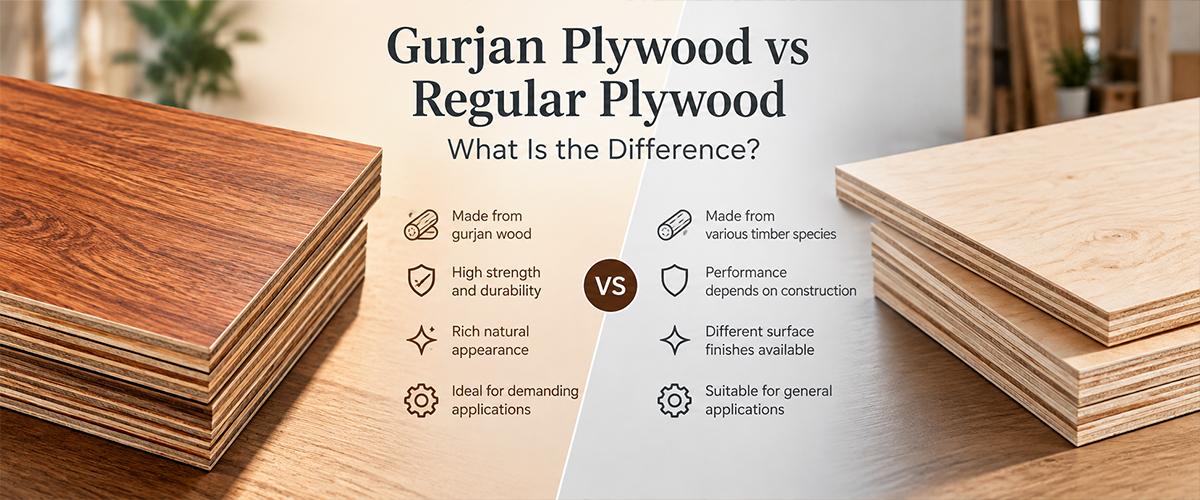
The difference between Gurjan plywood and regular plywood lies primarily in the timber used, construction, appearance, strength, stability, and intended application. Gurjan plywood is made using Gurjan wood and is known for its strength and durability. Regular plywood is a broader category that can include plywood made from different wood species, core constructions, and manufacturing processes.
Choosing between the two depends on the intended use, expected load, moisture exposure, surface finish, and budget.
What Is Gurjan Plywood?
Gurjan plywood is made using Gurjan wood and is valued for its strength, density, and durability. Gurjan is a hardwood species commonly used in plywood manufacturing, particularly for face veneers and quality plywood construction.
However, the performance of Gurjan plywood can vary depending on its core materials, bonding quality, thickness, and manufacturing process. Therefore, the term “Gurjan” alone does not provide a complete specification.
When comparing gurjan plywood vs regular plywood, it is important to evaluate the complete panel construction rather than the face veneer alone.
What Is Plain Plywood?
Regular plywood is not a specific wood species or a single grade. It is a broad term that can refer to plywood made using different timber species, core constructions, adhesives, and performance specifications.
It is used for various applications, including interior furniture, panelling, cabinetry, and other general-purpose projects. Its performance depends on the materials, grade, construction, and manufacturing quality of the panel.
This distinction is important because “regular plywood” does not represent one fixed type of construction.
Gurjan Plywood vs Normal Plywood: Key Differences
The key differences become clearer when factors such as timber, strength, stability, appearance, and intended application are considered.
| Factor | Gurjan Plywood | Regular Plywood |
|---|---|---|
| Timber | Uses Gurjan timber in its construction, depending on the product | Can use different wood species |
| Strength | Usually associated with strong hardwood construction | Depends on timber, core, and construction |
| Stability | Can provide good dimensional stability when well manufactured | Varies according to construction |
| Appearance | Valued for its natural veneer appearance | Depends on the face veneer used |
| Durability | Depends on grade and manufacturing quality | Depends on grade and manufacturing quality |
| Application | Furniture, cabinetry, and demanding applications, depending on specification | Wide range of general applications |
| Selection | Should be based on complete specifications | Should be based on grade and intended use |
The comparison is therefore not simply about choosing one material over the other. A well-specified regular plywood can be suitable for a particular application, while Gurjan plywood should also be selected according to the required performance characteristics.
Strength and Load-Bearing Performance
Strength is an important factor when comparing Gurjan plywood with normal plywood. Gurjan timber is a hardwood, and plywood incorporating it can provide a strong and stable panel when manufactured properly.
However, overall plywood performance is influenced by more than timber species. Core construction, veneer quality, adhesive bonding, thickness, and manufacturing consistency can all affect the finished panel.
For tables, cabinets, shelves, and other furniture components, select plywood according to the expected load and support arrangement rather than relying on the timber name alone.
Surface Finish and Appearance
The face veneer can influence the appearance of finished furniture and interiors. Gurjan plywood may be considered where the natural appearance of the face is important.
Regular plywood can also use different face veneers depending on the product. For visible applications, check the face quality, grain, surface uniformity, and finishing requirements before selecting the panel.
For applications where plywood will be laminated, painted, or covered, surface appearance may have less influence on the final choice.
Resistance to Moisture and Longevity
Neither Gurjan plywood nor regular plywood should be judged for moisture resistance solely by the timber species used. Grade, adhesive system, and construction determine whether a panel is intended for dry interiors, moisture-prone environments, or more demanding applications.
For kitchens, bathrooms, utility areas, or other locations where moisture exposure is expected, select a plywood grade designed for those conditions.
A Gurjan-faced panel does not automatically mean that the plywood is waterproof.
What’s Better for Furniture?
There is no single choice that suits every furniture application. Gurjan plywood may be considered when hardwood construction, strength, stability, and face appearance are important.
Regular plywood can also be suitable when a particular grade, thickness, or construction meets the project's requirements.
For furniture, consider:
- Expected load
- Panel thickness
- Core construction
- Exposure to moisture
- Screw-holding requirements
- Surface finish
- Dimensional stability
- Intended service life
These factors provide a more practical basis for selecting plywood than timber type alone.
Gurjan Plywood vs Regular Plywood for Different Applications
The suitable plywood can vary depending on where and how the panel will be used.
| Application | What to Prioritise |
|---|---|
| Tables and desks | Strength, stiffness, and thickness |
| Cabinets | Stability, screw holding, and surface finish |
| Shelves | Load capacity, span, and thickness |
| Wall panelling | Surface quality and dimensional stability |
| Kitchen furniture | Suitable moisture-resistant grade |
| Outdoor applications | Appropriate exterior-grade construction and moisture resistance |
The intended application should therefore be considered alongside the plywood's grade and construction.
How to Choose Between Gurjan and Regular Plywood
Start by identifying the conditions in which the plywood will be used. Check the plywood grade, timber construction, thickness, bonding quality, and manufacturer specifications.
If strength and appearance are important, Gurjan plywood may be worth considering. For projects with specific moisture, fire, precision, or structural requirements, choose a plywood grade that directly addresses those conditions, regardless of whether it is marketed as Gurjan or regular plywood.
The most reliable selection is based on the panel's construction and required performance rather than the timber name alone.
Conclusion
Gurjan plywood vs regular plywood is not simply a comparison between premium and ordinary material. Gurjan plywood uses Gurjan wood and can provide desirable strength, stability, and appearance, while regular plywood covers a wider range of wood species and constructions.
For the right choice, compare the plywood's grade, core construction, thickness, bonding, moisture resistance, surface quality, and intended application.
Frequently Asked Questions
Is Gurjan Plywood Better Than Ordinary Plywood?
Gurjan plywood can be a suitable option when strength, stability, and appearance are important. However, the appropriate choice depends on the plywood's grade, construction, and intended use.
Gurjan Plywood Vs Regular Plywood: What’s the Difference?
Gurjan plywood uses Gurjan wood, while regular plywood is a broader category that can include different wood species and construction types.
Is Gurjan Plywood Stronger Than Regular Plywood?
Gurjan plywood can provide high strength because Gurjan wood is a hardwood. However, overall performance also depends on thickness, core construction, adhesive, and manufacturing quality.
Is Gurjan Plywood Waterproof?
Gurjan plywood is made using Gurjan timber, but this does not automatically make it waterproof. Water resistance depends on the plywood's grade, adhesive system, and construction.
Gurjan vs. Regular Plywood: What’s Better for Furniture?
Both can be used for furniture. The suitable option depends on factors such as strength, stability, appearance, moisture exposure, thickness, and the specific furniture application.