Adhesive Selection for Plywood Projects: Types, Uses, and Guidelines
September 9, 2026
Table of Contents
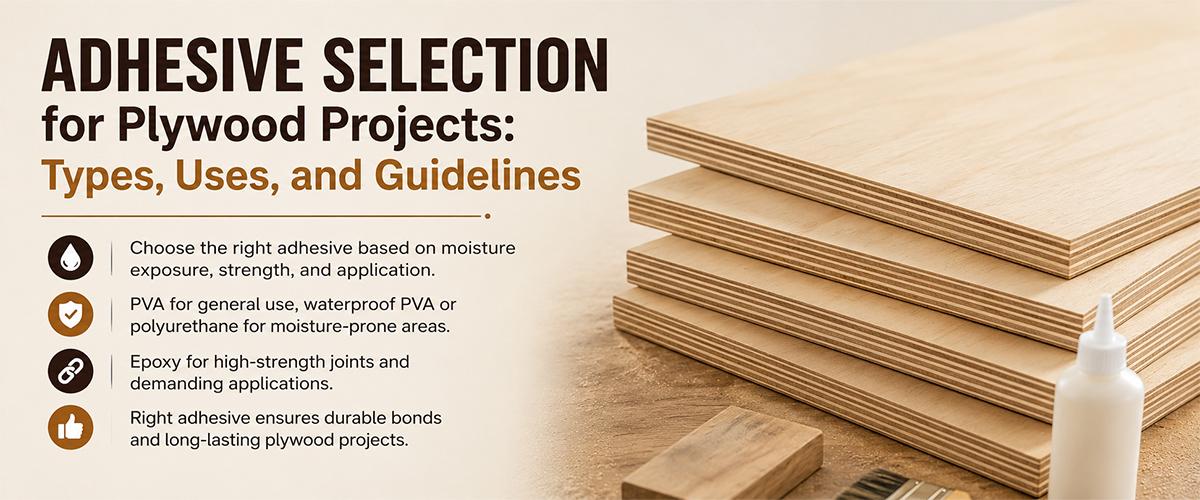
The choice of the best adhesive for plywood applications will mostly depend on the intended use of the material. For work on indoor furniture or cabinet assembly, the standard PVA glue is quite enough for general use. In places exposed to moisture, waterproof polyvinyl acetate or polyurethane will do a better job. Epoxy is good for joints that have increased stress levels. The most suitable adhesive for plywood projects is the one that takes into account exposure to moisture, joint strength, surface quality of the material, and the application.
The task of choosing the right plywood glue is very important. The use of improperly selected glue will lead to the joint breaking down, the material will be wasted, or the surface will peel, and this will apply even in case one has high-quality plywood. It is crucial to differentiate between the glue that is used in plywood manufacturing and the adhesive that is used for working with it. Factory-made plywood uses special bonding systems to hold the veneer layers together, while on-site project work requires more common types of adhesives like PVA, polyurethane, epoxy, or construction adhesive.
The ability to distinguish between different sorts of plywood glue will significantly facilitate the process of choosing the right product for various types of furniture and cabinetry assembly work, outdoor projects, subfloor construction, and repairs.
Manufacturing Adhesive vs. Project Adhesive
Manufacturing glue is applied inside plywood sheets during the production process. For construction purposes, interior plywood commonly uses urea-formaldehyde adhesives, while exterior plywood and marine-grade plywood products employ moisture-resistant bonding agents like phenol-formaldehyde. Project glue is not the same as manufacturing glue. Project glue is a substance that is utilised during the process of joining the pieces of plywood.
These are PVA glue, polyurethane adhesives, epoxy, construction adhesives, and contact cement. As a result, if the question revolves around what in plywood results in its water tightness, the response should pertain to its manufacturing adhesive, quality, construction, and treatment. When it comes to joining plywood sheets, you will need a proper adhesive for plywood.
Types of Adhesive Suitable for Plywood
PVA Wood Glue
PVA is one of the most frequently used types of plywood glue in the production of plywood furniture as well as in other woodworking processes. It is water-based, easy to work with, and offers effective bonding properties with clean and unblemished plywood surfaces.
The standard type of PVA is appropriate for such items as indoor cabinets and boxes, tables, drawers, in addition to other applications of woodworking.
Waterproof PVA Glue
The Type III PVA provides more moisture resistance compared with the regular PVA. Hence, this type is suitable for making pieces of outdoor furniture, thus ensuring that they can safely deal with humidity.
Pouring substances of this kind is just as simple as standard PVA, but it offers more moisture resistance properties.
Polyurethane Glue
Polyurethane glue is waterproof and works perfectly even with slightly imperfect joints. While curing, it will expand and fill small gaps in the treated wood.
Epoxy Resin Glue
Epoxy is a powerful glue that can bond not only plywood but also wood to other materials. Although epoxy may be a wonderful choice for plywood glue, it is often more costly and needs to be mixed before being applied.
Construction Adhesive
Construction adhesives are meant for large areas, as well as framing and subfloors, and similar applications. They are generally flexible and can manage minor irregularities.
They can be a solution where regular wood glue could not work, but they are hardly the first option when it comes to building furniture.
Contact Cement and Spray Adhesive
Contact cement is usually used for glueing laminates and veneers instead of creating joints. Spray adhesives are similarly effective in cases when a template is to be glued or in other situations when weight is not an issue.
Therefore, it would be wrong to consider these as the best glue for plywood in cases when a joint holds heavy weights.
Comparison of Plywood Adhesives
| Glue | Water Resistance | Bond Strength | Clamping | Ideal For |
|---|---|---|---|---|
| Basic PVA | Low to Moderate | Good | Yes | Indoor furnishings and woodworking |
| PVA Type III | High | Good | Yes | Outdoor furniture and humid environments |
| Polyurethane | High | Very Good | Yes | Filling spaces and outdoor connections |
| Epoxy | High | Excellent | Light/None | Severe joints and reinforcements |
| Construction Glue | High | Good | Usually Not | Construction bases, slabs, and similar applications |
| Contact Adhesive | Moderate | Moderate | No | Lamination and finishing |
How to Choose the Right Glue for Plywood
Consider Moisture Exposure
For furniture that is kept in dry interiors, basic PVA is enough. For outdoor or humid working places, choose Type III PVA or Polyurethane.
Consider the Stress on the Joint
Light furniture stakes do not require the best adhesive for plywood to make this joint. Epoxy is more appropriate for joint construction or highest-stress joints.
Assess the Joint Fit
That means tight furniture joints fit PVA glue or epoxy quite well. Polyurethane and construction glue are better for certain gaps present.
Assess the Type of Project
Cabinetry and furniture are made with pure, easily sandable glue; that is the best approach. The constructions where subfloors, frames and big panels are added are better made with construction glue.
Assess the Working Time
Normally, epoxy takes longer to prepare and cure, but its effectiveness compensates for the amount of time spent on it in some cases.
How to Use Plywood Glue Correctly
Ensure that the wood surfaces are clean and dry and free of dust, grease, and debris before applying plywood glue. Lightly sanding the surfaces helps to ensure that they bond well. Apply a uniform layer of plywood glue to the surfaces of the joint. Be careful not to apply too much glue, as excessive glue will lead to unnecessary squeeze-out and be troublesome to finish.
To make sure everything works perfectly, hold the two glued pieces in clamps until the glue dries. Do not over-tighten the clamps, as the glue will flow out of the joint too much if too much pressure is applied.
Make sure to eliminate any excess glue before it dries.
Common Mistakes to Avoid
Using PVA glue in wet conditions. Regular PVA glue may not hold in wet conditions. Not clamping. A lot of adhesive types need sustained pressure while the adhesive holds. Applying glue on dirty surfaces. Dust and dirt block the adhesive from forming a proper adhesive bond.
Applying too much glue.
Neglecting the joint fit: Adhesives’ effectiveness depends on their gap-filling capacities. Some cases of poor joint fitting may need proper gap-filling glue or better surface preparation. Applying load before its time: The adhesive could seem dry on the surface, but it does not mean that its complete hardening is accomplished. Always follow the manufacturer’s instructions as to the curing.
Preferring the strongest glue in every case: Stronger and more expensive glue is not necessarily the best choice. For many furniture works, a simple PVA glue could suffice. Employing contact adhesives for structural joints: Contact adhesives should be used for non-structural purposes like laminating or veneering and not for structural joints like load-bearing plywood.
Conclusion
The best glue for plywood depends not only on the strength and price of the adhesive. Simple PVA works for most indoor dry furniture, while water-resistant PVA and polyurethane should be used for moist environments. On the other hand, epoxy is more suitable for hard joints and repairs, while construction adhesives should rather be used for bigger construction projects.
Frequently Asked Questions
Which Adhesive Is Used for Plywood Production?
Different types of adhesives are used depending on the grade of plywood and purpose. Interior plywood is made with adhesives based on urea-formaldehyde, while outside and marine plywood could be produced with more suitable adhesives.
Can PVA Glue Be Used for Furniture?
PVA can be fine for some indoor furniture and carpentry uses when the surfaces are prepared properly, and the right amount of pressure is applied.
Which Is the Most Suitable Waterproof Adhesive for Exterior Plywood?
Water-resistant PVA glue or polyurethane would be better than regular PVA glue for exterior applications. The amount of moisture that the glue can endure should be taken into consideration.
Can Epoxy Be Used with Plywood?
Yes, epoxy has a broad range of applications, as it can be useful in various repairs as well as in gap filling,g so it can be used for high-stress joints. Proper mixing and preparation of the epoxy glue should be followed.
Should Plywood Be Clamped While the Glue Sets?
Many wood adhesives rely on pressing to keep the surfaces together while they harden. The amount of required pressure and time for clamping need to be established depending on the product.
What Are the Differences Between Wood Glue and Construction Adhesives?
Wood glue is aimed at making precise joints between two wooden pieces, while construction adhesives are meant for covering larger areas and applying to different surfaces.

Related Blogs