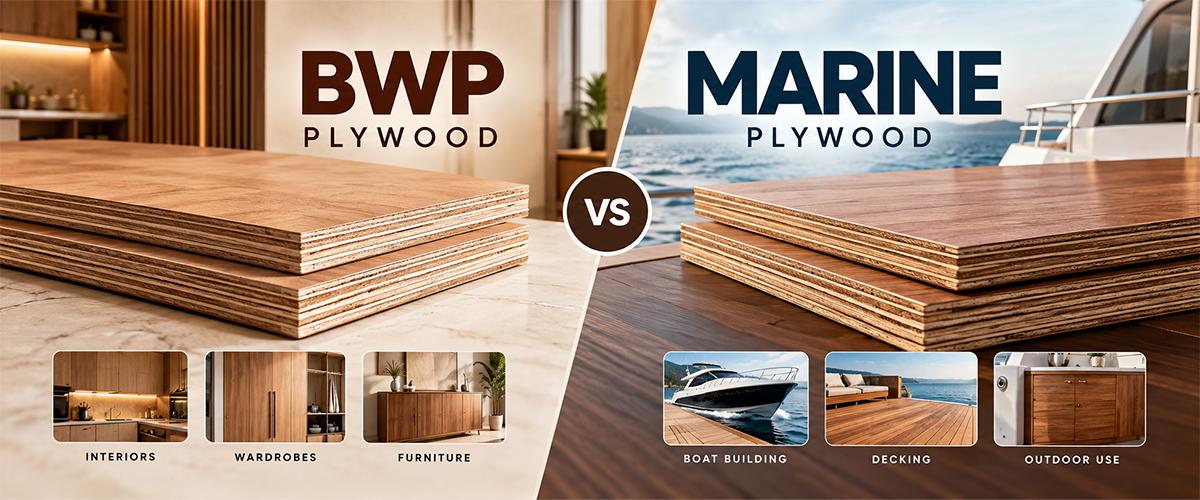
Marine Plywood vs Regular Plywood: What is the Difference between Marine Plywood and Regular plywood

December 9, 2025
Table of Contents
Plywood is a man-made wood panel created by gluing thin sheets of wood veneers together with heat and pressure. The direction of the grain of each layer alternates in relation to the previous layer, making plywood strong and giving it warp resistance.
While the basic build is similar, the real difference between marine plywood vs regular plywood is in the type of adhesive used, the quality of the veneers, and the method used to manufacture each. These three criteria affect the performance of each plywood in various application environments.
What is Regular Plywood?
Regular plywood, also known as commercial plywood or general-purpose plywood, is manufactured using a mix of hardwood and softwood veneers bonded with urea-formaldehyde resin. This composition offers decent strength along with moderate resistance to moisture, making it suitable for indoor applications. However, for spaces exposed to higher humidity or occasional water contact, it becomes important to evaluate better-performing options. understanding how marine plywood compares to waterproof plywood can help you decide which material will deliver the durability and protection required over time.
Royale Touche makes both Wooden Plywood Sheets and Hardwood Plywood in this category — both are perfect for interiors and areas where an improved finish, dimensional stability, and durability are required, and where limited moisture exposure occurs.
Common Uses for Regular Plywood:
-
Bedroom wardrobes and wall panels
-
Office tables and cabinetry
-
Ceiling panels and partitions
-
Indoor furniture and shelving
While durable and cost-effective, regular plywood is not good for areas with moisture or outdoor use. Overexposure to water will make the exterior veneer weak, and the board may swell or warp.
What is Marine Plywood?
Marine plywood is high-grade plywood designed specifically for constant wet and high humidity applications. It is made with high-grade hardwood veneers bonded with phenol-formaldehyde (PF) resin this makes it waterproof and gives the plywood special strength when resisting boiling water.
Royale Touche’s marine plywood is distinguished by its superior bonding value, vacuum-pressure chemical treatment for termite resistance, and strict quality control processes to ensure long-term dimensional stability.
Some Key Features include
-
100% waterproof and weather tolerant
-
Fungus, termite, and borer proof
-
High density and completely void-free core
-
100% IS:710 BWP (Boiling Water Proof) grade
-
Maintains integrity under extreme conditions
Some Typical Applications of Marine Plywood include
-
Modular kitchens and countertops
-
Bathroom cabinetry and vanities
-
Outdoor furniture and garden benches
-
Boat interiors and coastal construction
-
Decking and wet-area furniture
In summary, marine plywood vs regular plywood differences are subtle but come down to durability, bonding, and resistance to environmental factors such as moisture and humidity.
Marine Plywood vs Regular Plywood - Structural Composition
To understand what is the difference between marine plywood and regular plywood, it helps to look inside the structure of both products.
Regular Plywood Construction
-
A combination of hardwood and softwood veneers
-
Bonded using Urea formaldehyde resin
May include air gaps which can let moisture penetrate over time
Marine Plywood Construction
-
Made from 100% high-quality hardwood veneers
-
Bonded using waterproof phenol formaldehyde resin under hydraulic pressure
-
Totally void-free core to prevent water entry and delamination
-
Chemically treated against decay and marine organisms
The inherent differences between marine plywood vs regular plywood are what make marine-grade plywood outperform in challenging environments like humid or wet conditions where regular plywood would eventually fail.
Durability and Performance
Where we see clear differences in marine plywood vs regular plywood is durability. Regular plywood is perfect for dry interiors, while marine plywood is designed for moisture-heavy environments.
Marine Plywood
-
Stays pliable and intact under submersion in boiling water
-
Will not delaminate or lose bonding in coastal or wet surroundings
-
Provides longer life and superior loading strength
Regular Plywood
-
Performs well in dry indoor settings
-
Will swell or warp with extended contact with moisture
-
Requires sealing or lamination to enhance lifespan
If you are asking what is the difference between marine plywood and regular plywood, the simple answer is that marine plywood is made to endure water and weather, while regular plywood is best for standard indoor use.
Benefits of Marine Plywood
Marine plywood is created to function in water-saturated and harsh environments, employing high-grade plywood and durable water-resistant phenol formaldehyde glue.
Key Benefits
- Best water resistance
- Great stability
- Strong bonding, thus protecting plywood from delamination
- Extremely durable construction, able to withstand large weights
- Reliable structure that needs minimum maintenance
- Can be used in wet surroundings and outdoor areas
Benefits of Regular Plywood
Plywood is an inexpensive and good option for indoor places without moisture; it is affordable and reliable.
Key Benefits
- Cheap material for interiors, whether commercial or residential
- Versatile design and usage
- Lightweight material, easy to work with
- Smooth finish due to paints and varnish
- Different prices available
- Could be used for furniture and interior design
- Well-balanced dimensions
Tips for Choosing Marine Plywood
To choose a good marine plywood for successful implementation of a sheet in someone’s project, these aspects should be taken into account when buying marine-graded plywood.
- Look for marine plywood with IS:710 BWP certification.
- Make sure that plywood is made with phenol formaldehyde resin.
- Check the presence of quality hardwood veneer.
- Check for protection from fungi and termites.
- Select the necessary thickness.
- Buy from a known supplier.
- Make sure that the thickness is stable as well as quality and edges.
- Check whether the plywood meets requirements of India regulations.
Cost and Value Comparison
Although costs guide material selection, considering long-term value helps justify investment. Regular plywood is economical and a great fit for dry indoor areas like bedrooms, living rooms, or offices.
Marine plywood, however, has greater long-term value for applications in or around water because it resists damage, termites, and structural degradation. While marine plywood may cost more initially, its longevity saves money on replacements and repairs. It’s an investment in quality and peace of mind.
Choosing Between Marine Plywood vs Regular Plywood
Choosing between marine plywood vs regular plywood depends entirely on your usage and environment.
Choose Regular Plywood for
-
Indoor furniture
-
Wardrobes and ceilings
-
Any dry space with minimal moisture exposure
Choose Marine Plywood for
-
Kitchens and bathrooms
-
Balconies or outdoor setups
-
Coastal and humid environments
Ultimately, what is the difference between marine plywood and regular plywood is about performance. Regular plywood suits dry interiors, while marine plywood excels in wet, humid, or high-variation climates.
Environmental and Safety Standards
Both marine plywood and regular plywood from Royale Touche contain low-emission adhesives (E-0 certification), ensuring minimal formaldehyde release and better air quality indoors. Because marine plywood lasts longer, it minimizes replacements, reducing environmental waste. Both varieties are crafted from responsibly sourced timber, ensuring sustainability in modern interior design.
Summary: Marine Plywood vs Regular Plywood
| Features | Marine Plywood | Regular Plywood |
|---|---|---|
| Adhesive | Phenol-formaldehyde (waterproof) | Urea-formaldehyde (moisture resistant) |
| Core Quality | High-quality hardwood, no voids | May include small air voids |
| Resistance | Waterproof, fungus, termite & borer proof | Limited moisture resistance |
| Durability | Long lifespan under all weather | Dry interior use only |
| Price | Higher (premium quality) | Moderate (economical) |
If you’re comparing marine plywood vs regular plywood, it’s clear that marine plywood stands out for strength, reliability, and long-term performance. Another important comparison for buyers is between marine plywood and commercial plywood, especially when deciding based on budget, durability, and exposure to moisture.
Conclusion
To summarize, the choice between marine plywood vs regular plywood depends on your specific needs. For dry interiors and furniture, regular plywood offers practicality and cost efficiency. But for durability, strength, and protection against humidity and water marine plywood stands unmatched.
Knowing marine plywood vs regular plywood differences allows you to choose wisely not just based on price but on performance and longevity. Royale Touche Plywood guarantees that every sheet of plywood whether marine or regular reflects superior craftsmanship, sustainability, and reliability for interiors built to last.
Frequently Asked Questions
Is Marine Plywood Completely Waterproof?
Marine plywood consists of water-proof phenol resin; that is why it is water-resistant. Still, completely waterproof is a myth. Nevertheless, IS:710 marine plywood is the best in humid conditions.
What Is the Difference Between Marine Plywood and Regular Plywood?
The main difference lies in the quality of the materials and the moisture resistance. Marine plywood is made of high-quality wood veneer and water-resistant phenol resin, while regular plywood is made of usual wood and is designed for indoors.
How Can I Identify Genuine Marine Plywood?
Quality marine plywood can be defined with the help of IS:710 BWP certificates, water-resistant phenol resin and the presence of good-quality veneer core.
Can you make regular plywood waterproof?
Regular plywood can be coated or laminated for moisture protection, but it will never be as waterproof as marine plywood.
Is marine plywood stronger than regular plywood?
Yes, marine plywood is made with high-quality hardwood veneers and waterproof bonding for maximum strength and durability.
Can you use marine plywood in home interiors?
Yes, marine plywood can be used in kitchens, bathrooms, and furniture exposed to water or moisture.
Does Royale Touche have certified marine plywood?
Yes! Royale Touche’s IS:710-rated marine plywood is true boiling waterproof quality.
How long does marine plywood last compared to regular plywood?
Marine plywood can last decades with minimal maintenance, while regular plywood is suited for shorter-term, dry interior applications.

Related Blogs